
How to Explain Decimals to Kids: A Parent's Guide for Grades 4–6
Why kids think 0.25 is bigger than 0.5, a 2-minute check that shows which rule your child is using, and how to explain decimals in grades 4 to 6.
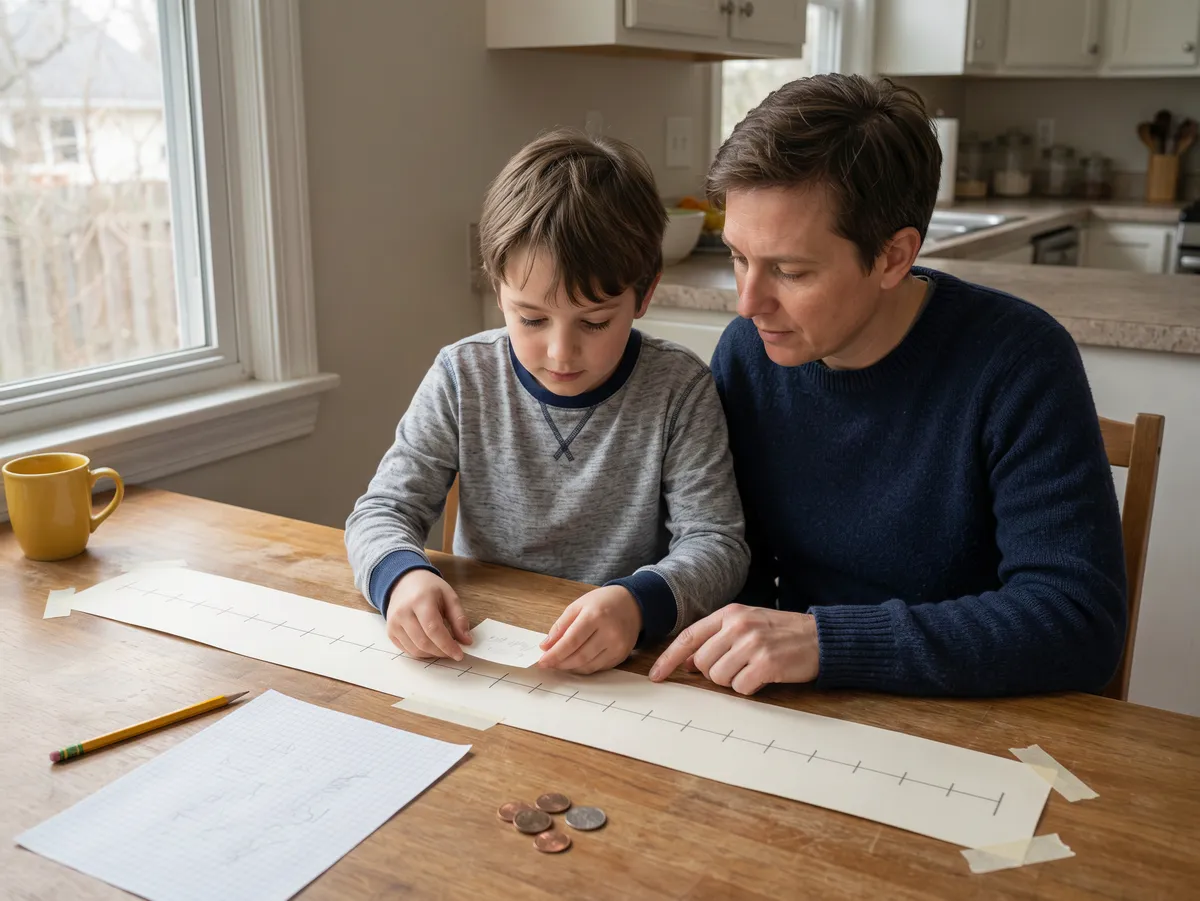
Ask a fourth grader which is bigger, 0.25 or 0.5, and there is a good chance the answer is 0.25. Twenty-five is bigger than five, after all. It is the most common decimal mistake there is, and it is not carelessness: your child is applying a rule that has worked for every number they have met so far.
That is good news, because a mistake that comes from a rule can be found in two minutes and fixed where it starts. This guide shows you how to explain decimals to kids in grades 4 to 6: what a decimal actually is, four questions that reveal which rule your child is using, a fix for each rule, what each grade expects, and where adding and multiplying decimals usually go wrong.
If Your Child Gets This Wrong, They Have Company
Researchers at the University of Melbourne, Vicki Steinle and Kaye Stacey, tracked more than 3,000 Australian students in grades 4 to 10 over four years, testing them every six months or so on one thing: which of two decimals is bigger. In their results, 74% of fourth graders judged the longer decimal to be the larger one. In fifth grade it was 46%, and in sixth grade a third. Even in grade 10, only about 70% answered like experts.
American students are no different. A US Department of Education practice guide reports that on the 2004 National Assessment of Educational Progress, fewer than 30% of 17-year-olds correctly translated 0.029 into 29/1000. A gap left in fifth grade does not close by itself.
What a Decimal Actually Is
A decimal is a fraction whose bottom number is 10, 100 or 1,000, written another way. 0.5 is five tenths, or 5/10. 0.25 is twenty-five hundredths, or 25/100. 0.457 is four hundred fifty-seven thousandths. The decimal point marks where the whole numbers stop and the tenths begin.
That is how school introduces them, too. The Common Core standard 4.NF.C.6 asks fourth graders to “use decimal notation for fractions with denominators 10 or 100”. Decimals arrive as a new way of writing fractions, not as a new kind of number. So a child who is unsure about fractions will be unsure about decimals for the same reason, and our guide to helping your child master fractions covers that side.
Say Decimals by Their Names
Most adults read 0.25 aloud as “zero point two five”. That hides the one thing a child needs to hear. Say “twenty-five hundredths” and “five tenths”, and the question changes from which number is bigger to which pieces are bigger, and how many are there — which is the right question. The standards ask for this as well: fifth graders are expected to read and write decimals using “number names” (5.NBT.A.3a).
The 2-Minute Decimal Check
Ask these four questions one at a time, on paper. Don't correct anything until the end: you are collecting evidence, and a corrected answer tells you nothing. After each one, ask “How do you know?” The reason is worth more than the answer.
Question 1
Which is bigger?
0.5 or 0.25
Question 2
Which is bigger?
0.4 or 0.457
Question 3
Which is bigger?
0.3 or 0.30
Question 4
Draw a line from 0 to 1. Where do these go?
0.7 and 0.07
The answers: 0.5 is bigger. 0.457 is bigger. 0.3 and 0.30 are the same. On the line, 0.7 goes most of the way along, seven tenths of the way, and 0.07 sits just past 0.
What the Answers Tell You
Wrong on 1, right on 2
Longer is larger
The digits after the point are being read as a whole number: 25 beats 5, and 457 beats 4. This child usually says 0.30 is bigger than 0.3 as well. It is the most common pattern in fourth and fifth grade.
How to fix itRight on 1, wrong on 2
Shorter is larger
This child has learned that hundredths and thousandths are small pieces, and over-applied it: more digits must mean a smaller number. It looks like progress, and partly is, but it is still a rule.
How to fix itRight on 1–3, lost on 4
Right answers, no sense of size
A rule for comparing is working, but the numbers have no place yet. If 0.07 lands near 0.7, or anywhere past the middle, the number line below is the next step.
The number lineAll four right, with reasons
Solid — with one more check
If every reason is about dollars and cents, ask one more: 0.45 or 0.452? A child who says they are the same (“both 45 cents”) has been getting by on money, which stops at two places.
Why money isn’t enoughHow to Explain Decimals When Longer Seems Larger
This is the rule from the opening: the digits after the point are read as a whole number. Don't argue with it. Show your child something it cannot explain.
Shade a 10 × 10 Grid
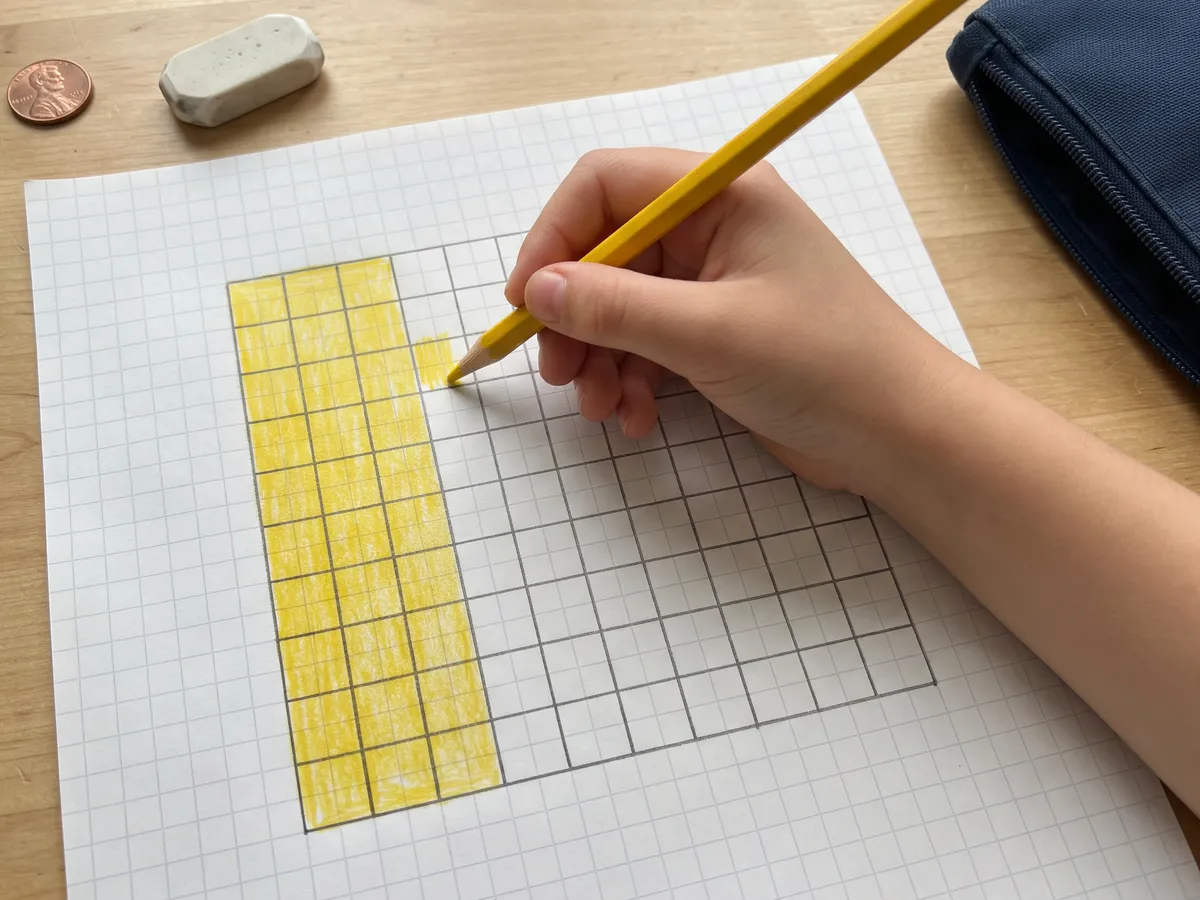
Draw a 10 by 10 square, or use graph paper. The whole square is 1. Each column is a tenth, and each small square is a hundredth. Shade 0.5: five columns. Shade 0.25: two columns and five squares. No rule is needed now, because your child can see which is bigger. The Department of Education's guide notes that many students learn decimals with exactly this “100 grid”, and that the same grid shows why adding decimals is adding hundredths: 2.34 + 1.69 is 234/100 + 169/100.
Fill In the Zero, After the Grid
Once the grid makes sense, show that 0.5 and 0.50 are the same shaded area: five tenths is fifty hundredths. Now both numbers are counted in the same pieces, 50 hundredths against 25. Writing the zero is a good way to check an answer, but teach it after the grid, not instead of it. A child who adds zeros because they were told to has learned a new rule, not decimals.
Use a Number Line Marked in Tenths
Mark 0 and 1 on a strip of paper, then the nine tenths between them. Where does 0.25 go? Between the second and third marks. Where does 0.5 go? On the fifth. Teach your child to look at the tenths digit first, because it says which tenth the number sits in. This approach has been tested: in a study described in the Department of Education's guide, fifth and sixth graders who practiced placing decimals on a number line divided into tenths, with a prompt to notice the tenths digit, became more accurate than students whose lines were not divided and who got no prompt.
Money Helps, Up to Two Places
Money is the explanation most parents reach for first, and it does help: 50 cents is plainly more than 25. Our math activities that don't look like school include a few good money games. But the Melbourne researchers warn about students who look like experts because they read every decimal as dollars and cents, and who are unsure of anything past the second digit. Money has no thousandths. Use it as a first step, then move to the grid and the number line, which keep working at three places and beyond.
When Shorter Seems Larger
This child knows something true: a thousandth is far smaller than a tenth. They are drawing the wrong conclusion from it, by looking at the size of the pieces and ignoring how many there are. The Melbourne researchers give the example of a child deciding that 0.4 is bigger than 0.83. In their data this pattern showed up in 14% of fifth graders and 19% of sixth graders. Some children in this group read 0.3 as 1/3 and 0.4 as 1/4, and conclude that 0.3 must be bigger.
The fix is to make the pieces the same size. 0.4 is four tenths, which is 400 thousandths. 0.457 is 457 thousandths. Same-size pieces, and 457 is more. Then go back to the number line: 0.457 sits just past the 0.4 mark, between 0.4 and 0.5, so it cannot be smaller than 0.4.
What Each Grade Expects
The Common Core standards, which many states' standards are built on, spread decimals across three years. States that wrote their own standards follow a broadly similar order, though a topic can arrive a year earlier or later; your child's teacher can tell you where yours puts it.
4th grade
Tenths and hundredths, as fractions first
Fractions out of 10 and 100 come before the decimal point does: 3/10 + 4/100 = 34/100 (4.NF.C.5). Then the new notation for them, 0.62 for 62/100, placed on a number line (4.NF.C.6). Then comparing two decimals to hundredths “by reasoning about their size” (4.NF.C.7). No arithmetic with decimals yet.
5th grade
Thousandths, and all four operations with models
Each place is worth ten times the place to its right (5.NBT.A.1). Read, write and compare to thousandths, including expanded form (5.NBT.A.3), round (5.NBT.A.4), and explain where the point moves when multiplying or dividing by 10, 100 or 1,000 (5.NBT.A.2). Add, subtract, multiply and divide to hundredths “using concrete models or drawings” and place value (5.NBT.B.7).
6th grade
Fluent written methods
“Fluently add, subtract, multiply, and divide multi-digit decimals using the standard algorithm for each operation” (6.NS.B.3). Sixth grade also starts using decimals inside ratios and percents, so a gap left here does not stay a decimal gap for long.
Notice the order. In fifth grade the standards ask for models, drawings and reasons, and the fast written method waits until sixth. A shortcut taught early (“just count the decimal places”) gets the right answer while skipping the understanding fifth grade is there to build. That is why it so often fails the first time a problem looks different. Our readiness checklists for 4th, 5th and 6th grade show where decimals fit among everything else that year.
Where Adding and Multiplying Decimals Go Wrong
Most mistakes with decimal arithmetic come from the same place as the comparison mistakes: a rule that was true for whole numbers, carried over to decimals.
Adding: 0.5 + 0.25 = 0.30
Read the parts after the point as whole numbers and 5 + 25 is 30. Have your child estimate first: a half plus a quarter is three quarters, so the answer has to be near 0.75. Then line up the decimal points, which really means lining up tenths with tenths and hundredths with hundredths. Writing 0.5 as 0.50 makes the columns obvious.
Multiplying: “Times Makes It Bigger”
For every whole number your child has multiplied, the answer got bigger. Then 0.5 × 8 comes out as 4, smaller than 8, and a child who expects bigger will distrust a right answer or move the point to make it 40. When one number is less than 1, read the “×” as “of”: 0.5 × 8 is half of 8. The same habit turns 0.3 × 0.2 into 0.6. Three tenths of two tenths is six hundredths, 0.06, and the grid shows it: shade three columns, then two rows, and only six small squares are shaded twice.
Dividing: 6 ÷ 0.5 = 3
Division made numbers smaller too, until now. The answer is 12, and the question that makes it make sense is “how many halves fit into 6?” It is the same question that makes dividing fractions make sense in sixth grade, and it is worth asking the same way both times.
Fractions and Decimals Are the Same Numbers
The Department of Education's guide recommends teaching fractions, decimals and percents as “just different ways of representing the same number”, on one number line, with fractions written above it and decimals or percents below. Its own example is placing 3/4, 0.75 and 75% on a line from 0 to 1. You can do it at home with a strip of paper: put 1/2 and 0.5 on the same mark, then 1/4 and 0.25, then 3/4 and 0.75.
A handful are worth knowing by heart, because they come up all the time: 1/2 = 0.5, 1/4 = 0.25, 3/4 = 0.75, 1/5 = 0.2, 1/10 = 0.1, and by sixth grade 1/8 = 0.125. A child who knows these finds sixth-grade percents far easier, because 0.25 is twenty-five hundredths, and twenty-five hundredths is 25%.
This matters beyond decimals. In US and UK data, Siegler and colleagues found that elementary school students' knowledge of fractions and division predicted their algebra knowledge and overall math achievement in high school, five or six years later, even after accounting for their other math knowledge, general intellectual ability, working memory, and family income and education. Decimals are fractions, so this is that same foundation. It is also the one pre-algebra leans on hardest.
When It's More Than Practice
A few weeks with a grid and a number line fixes most of what the check turns up. If it doesn't, or the same rule is still there in sixth grade, the gap is usually in fractions underneath it, and it is worth catching before ratios and percents are built on top. Our post on the signs your child needs a math tutor has a check for each sign and what to do about it. Each grade's tutoring page sets out what the year covers and where it usually comes apart: 4th, 5th and 6th grade.
The Cheapest Next Step
We offer online 1-on-1 math tutoring for grades 1 to 8, and the first lesson is free. A teacher works with your child for a full lesson, then you get a written summary of what was covered, how your child did, and one thing to practice. Book a free trial lesson and find out where your child's decimals really stand.
Frequently Asked Questions
What grade do kids learn decimals?
In the Common Core standards, fourth grade: tenths and hundredths, written as fractions out of 10 and 100 before the decimal point appears. Fifth grade adds thousandths and all four operations using models and drawings, and sixth grade expects fluent written methods. States that wrote their own standards follow a broadly similar order.
Why does my child think 0.25 is bigger than 0.5?
They are reading the digits after the decimal point as a whole number, and 25 is bigger than 5. It is very common: in a University of Melbourne study of more than 3,000 students, 74% of fourth graders and 46% of fifth graders judged the longer decimal to be larger. Shading 0.5 and 0.25 on a 10 by 10 grid usually settles it, because the child can see which is bigger.
Is money a good way to teach decimals?
As a first step, yes: 50 cents is obviously more than 25. But money stops at two decimal places, and researchers have described students who look like experts because they read every decimal as dollars and cents, then come unstuck at thousandths. Move on to a 10 by 10 grid and a number line, which keep working past two places.
Should kids learn fractions or decimals first?
Fractions. The standards introduce decimals in fourth grade as a new way of writing fractions with denominators of 10 and 100, so a decimal is a fraction written another way. A child who is unsure what a fraction is will usually be unsure about decimals for the same reason.
How do you explain decimals on a number line?
Mark 0 and 1, then divide the line into tenths. Teach your child to look at the tenths digit first, because it says which tenth the number sits in: 0.25 is between the second and third marks, 0.5 is on the fifth. A study described in a US Department of Education practice guide found that this approach made fifth and sixth graders more accurate at placing decimals.
Why is 0.5 × 8 smaller than 8?
Because multiplying by a number less than 1 takes part of the other number. Reading the times sign as “of” makes it clear: 0.5 × 8 is half of 8, which is 4. Children expect multiplication to make numbers bigger because it always has with whole numbers, so it is worth saying out loud.
Try Your First Math Lesson Free
See how 1-on-1 online math tutoring can change everything for your child. No credit card required.
Book a Free TrialKeep Reading
Math Word Problem Keywords: The Strategy Most Kids Are Taught Doesn't Work
Most kids are taught to hunt for keywords in math word problems. Research says it fails on 9 of 10 multi-step problems. Here's what works instead.
ReadMultiplication Facts: The Only 15 Your Child Has to Memorize
A multiplication chart has 100 squares, but only 15 multiplication facts are truly hard. See the list, the teaching order, and what research says.
Read