
4th Grade Math: What Your Child Should Know Before Day One
The 4th grade math skills your child needs on day one — seven kitchen-table checks, the exact question to ask for each, and what each answer tells you.

Fourth grade is where math stops being forgiving. Third grade introduces multiplication, fractions and two-step problems; fourth grade assumes all three are already settled and starts building on top of them. A child who finished third grade still working out 7 × 8 on their fingers will not fail in September — they will fail in November, when long division asks them to do that same calculation forty times inside one problem.
The good news is that this is the easiest thing in the world to check, and it takes about five minutes at the kitchen table. Below are seven checks, each one tied to a skill fourth grade genuinely assumes. For each, there is the specific question to ask and — more usefully — what the answer actually tells you.
You are not marking a test. You are watching how your child answers, which is where the real information is.
What 4th Grade Assumes on Day One
The skills below are not a wish list. They are what the third-grade standards say a child should leave third grade holding, and fourth-grade material is written on the assumption that they do.
One of them is worth quoting exactly, because the wording is stronger than most parents realise. The Common Core standard for third-grade multiplication and division, 3.OA.C.7, asks students to "fluently multiply and divide within 100" and then adds: "By the end of Grade 3, know from memory all products of two one-digit numbers."
Know from memory. Not "can work out." Not "gets there eventually." That distinction is the single most useful thing in this article, and it is the one every skills list leaves out.
The Five-Minute Readiness Check
Do these out loud, in any order, over a snack. Do not announce it as a test — a child who thinks they are being assessed will freeze, and you will learn nothing about what they actually know.
1. Multiplication Facts, From Memory
Why it matters: Everything in fourth grade — multi-digit multiplication, long division, equivalent fractions, factors and multiples — runs on instant recall. A child who computes rather than recalls spends their working memory on the facts and has none left for the actual problem.
Quick check: Ask six facts from the hard end, not the easy one: 7 × 8, 6 × 7, 9 × 6, 8 × 4, 7 × 9, 6 × 8.
What the answer tells you: Answers inside about three seconds are recall. A pause with lips moving, fingers tapping, or a visible "6, 12, 18, 24…" is skip-counting — the child is deriving the fact, not knowing it. Both produce the right answer today. Only one survives long division.
2. Division as the Flip Side
Why it matters: The same standard asks for division fluency, and it is usually much weaker than multiplication because it gets a third of the practice. Long division in fourth grade needs both, alternating, at speed.
Quick check: "If 8 × 5 is 40, what is 40 ÷ 5?" Then, separately, "What is 56 ÷ 7?"
What the answer tells you: If the first is instant but the second is a struggle, your child knows the multiplication table but has not connected it to division — they are two separate lists in their head instead of one relationship. That is a quick fix, and a genuinely important one.
3. Fractions as Numbers, Not Pictures
Why it matters: Third grade is where a fraction stops being a shaded shape and becomes a number with a place on the number line. Fourth grade adds, subtracts and compares them. A child who only ever saw pizzas has nothing to stand on.
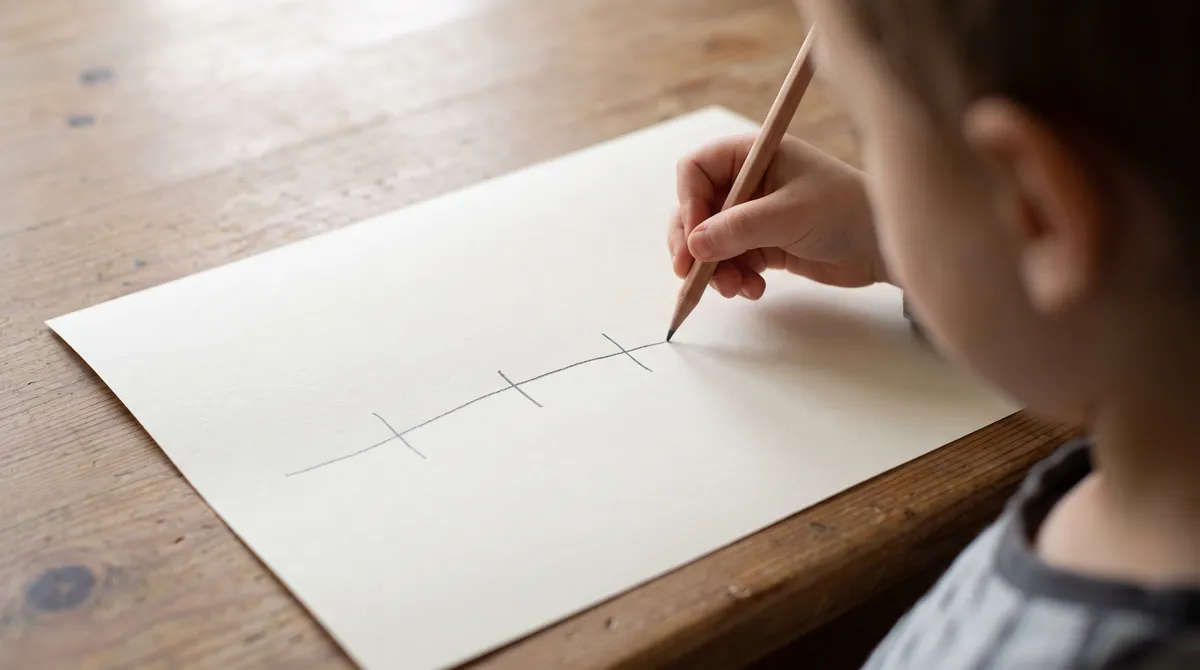
Quick check: Draw a line, mark 0 and 1, and ask them to put 3/4 on it. Then ask them to put 5/4 on it.
What the answer tells you: 3/4 is easy for most. The second question is the real one — a child who says 5/4 "can't go there" or tries to squeeze it between 0 and 1 is still thinking of fractions as parts of one object, not as numbers. Our guide to helping your child master fractions starts exactly here.
4. Equivalent Fractions
Why it matters: Fourth grade compares fractions with unlike denominators constantly. That is impossible without seeing that 1/2 and 2/4 are the same amount wearing different clothes.
Quick check: "Which is bigger, 2/3 or 2/6?" Then: "How do you know?"
What the answer tells you: The second question matters more than the first. "Because 3 is smaller than 6" is a guess that happens to land. What you want is something about the pieces being bigger when you cut the same thing into fewer of them. A child who reasons about size is ready; a child who compares the digits is running a rule that will break the moment the numerators differ.
5. Adding and Subtracting Within 1,000
Why it matters: Long division subtracts, repeatedly, inside every single problem. Shaky borrowing across zeros turns one division question into six chances to go wrong.
Quick check: Write 604 − 358 and let them work it on paper.
What the answer tells you: This one is chosen deliberately: the zero in the middle forces borrowing twice in a row, which is where regrouping breaks if it was ever shaky. Watch the process, not just the answer — a child who gets 246 but takes a long, uncertain route will not survive doing this inside a bigger problem.
6. Area and Perimeter
Why it matters: Both are third-grade content, and fourth grade treats them as known while adding unknown side lengths and multi-step problems. They are also where multiplication quietly reappears.
Quick check: "A rectangle is 7 across and 4 down. What is its area? What is its perimeter?"
What the answer tells you: Mixing the two up is the common answer and it is not a memory problem — it means the child learned two formulas without ever picturing what each one measures. Ask which one tells you how much carpet you need. If that lands, the concept is there and only the labels are loose.
7. Two-Step Word Problems
Why it matters: Third grade expects children to solve two-step word problems using all four operations. Fourth grade rarely asks a one-step question again.
Quick check: "Maya buys 4 packs of pencils. Each pack has 6 pencils. She gives 5 to her brother. How many does she have left?"
What the answer tells you: Watch for the child who does 4 × 6 and stops at 24 — they answered the question they could see rather than the one that was asked. That is a planning gap, not an arithmetic gap, and it is treated completely differently. If your child hunts for keywords like "left" to decide what to do, read why keyword strategies fail on word problems before doing anything else — that habit actively causes this.
The Check That Predicts the Most Trouble
If you only have time for one, do the first one — and time it.
Every readiness list ever written says "knows their multiplication facts." Almost none of them tell you where the line is, which makes the advice impossible to act on. Here is the line, in the standard's own words: from memory. A fact your child retrieves is a fact that costs nothing. A fact your child rebuilds — by skip-counting, by adding a group on, by working up from 5 × 8 — costs several seconds and, far more importantly, occupies the exact mental space the rest of the problem needs.
This is why a child can be genuinely good at math and still fall apart in fourth grade. Nothing is wrong with their reasoning. They are simply paying for their times tables over and over, in the middle of problems that need every bit of attention they have.
It is also the most fixable item on this entire list. Fact fluency responds to short, frequent, low-stakes practice better than almost anything else in elementary math — see how to help your child memorize the multiplication facts for what actually works and what wastes the summer.
What 4th Grade Will Ask For
For context on why the seven checks above are the ones that matter, here is what they are feeding:
- Multi-digit multiplication — 4-digit by 1-digit, and 2-digit by 2-digit
- Long division with one-digit divisors, including remainders
- Adding and comparing fractions with related denominators, and mixed numbers
- Decimals to hundredths, and their link to fractions
- Factors, multiples and prime numbers
- Multi-step word problems using all four operations
Every one of those sits directly on top of something in the checklist. If you want the view from inside the year rather than the doorway, our guide to the most common math struggles in 4th grade covers what actually goes wrong once it is under way — and how each one is usually fixed.
If You Found Gaps
Finding two or three is normal. Third grade is a big year and almost nobody leaves it with everything airtight — the point of checking in September is that a gap costs a few weeks now and a whole term in February.
Two things worth knowing. First, fix them one at a time. A child working on fact fluency and fractions and word problems at once makes no visible progress at any of them and concludes they are bad at math. Second, work backwards, not forwards. If fractions are shaky, more fourth-grade fraction worksheets will not help; the third-grade number line will. That is the whole method — and it is also why checking now, before the material piles on, is worth five minutes at the kitchen table.
If you would rather not diagnose it yourself, that is exactly what our 4th grade math tutors do in the first lesson: work out which of these seven are solid and which are not, then start at the earliest one that is shaky rather than at whatever the class is doing this week. The first 1-on-1 online lesson is completely free — book a trial and we will tell you plainly where your child stands.
Looking further ahead, or have an older child too? The 5th grade readiness checklist does the same job a year on, and the 3rd grade checklist covers the year these skills were built.
Frequently Asked Questions
What math should a child know before starting 4th grade?
The core of it: multiplication and division facts within 100 known from memory, adding and subtracting within 1,000 with regrouping, fractions understood as numbers on a number line, equivalent fractions, area and perimeter, and two-step word problems using all four operations. These are the third-grade standards that fourth grade builds directly on top of.
How fast should a 4th grader know their multiplication facts?
The standard asks for facts known from memory by the end of third grade, which in practice means retrieved in about three seconds rather than worked out. Speed itself is not the goal — the point is that a recalled fact costs no mental effort, leaving working memory free for the actual problem. A child who skip-counts to reach 7 x 8 will still get the right answer, but will struggle once that calculation sits inside long division.
My child is behind in a few of these. Is that a problem?
Finding two or three gaps is normal and fixable. What matters is fixing them one at a time and working backwards to the earliest shaky skill rather than drilling the current grade's material. A gap caught in September usually costs a few weeks; the same gap found in February costs a term, because everything built on it in between also has to be repaired.
Is this the same as knowing what goes wrong during 4th grade?
No, and the difference is useful. This checklist covers what a child should already hold when fourth grade begins, which is third-grade content. Our separate guide to common 4th grade math struggles covers what tends to go wrong during the year itself, such as long division and multi-digit multiplication. Use this one in August or September, and that one once the year is under way.
Try Your First Math Lesson Free
See how 1-on-1 online math tutoring can change everything for your child. No credit card required.
Book a Free TrialKeep Reading
Is Your Child Ready for 2nd Grade Math? A Back-to-School Checklist
What your child needs before 2nd grade math — why tens and ones decide the year, plus six quick checks you can run at the kitchen table.
ReadIs Your Child Ready for 1st Grade Math? A Back-to-School Checklist
What your child actually needs before 1st grade math — the two skills that predict the year, plus a five-minute check you can run at home.
Read