
6th Grade Math: A Back-to-School Checklist for the Middle School Jump
6th grade changes two things at once — a new school and a new kind of math. The checklist of skills your child needs locked in, and what's coming this year.

Sixth grade asks your child to change two things at once. The school changes — multiple teachers instead of one, more homework, and far more responsibility for keeping track of it all. And the math changes, too: after years of computing answers, students are suddenly asked to reason about relationships between quantities.
That double jump is why sixth grade catches so many capable students off guard.Studies of the New York City and Florida school systems found that students who move into a middle school in sixth grade score about 0.12 standard deviations lower in math than comparable students who stay in a K–8 school — the equivalent of roughly four months of expected learning, and a gap that was still measurable at the end of eighth grade. It is a real transition, not just a nervous first week.
The good news is that both halves of the jump can be prepared for. Here's the checklist of skills to have locked in before day one, what's genuinely new this year, and the non-math habits that decide how smoothly it goes.
What Actually Changes in 6th Grade
The math shifts from arithmetic to relationships. Up through fifth grade, most problems asked "what is the answer?" Sixth grade asks "how do these two quantities compare?" Ratios, rates, and percentages take over — in fact, ratios get more instructional time than any other topic in the year. Negative numbers show up for the first time, and letters start standing in for numbers in real algebraic expressions.
The school shifts, too. Instead of one teacher who knows your child all day, there are several — each with their own expectations, pace, and grading. Nobody is tracking whether your child wrote down the homework. A student who was quietly carried by a great elementary teacher now has to carry a bit of it themselves.
Both changes reward the same thing: solid fundamentals that don't need conscious effort, leaving room for new ideas and new routines.
The Back-to-School Readiness Checklist
Before the first day, your rising sixth-grader should be comfortable with these six things — the fifth-grade foundations that sixth grade immediately builds on. Each takes a couple of minutes to check at the kitchen table.
1. Fraction Operations — All Four
Why it matters: Sixth grade adds dividing fractions by fractions, and treats everything before it as known. Ratios are written as fractions too, so fraction weakness quietly becomes ratio weakness.
Quick check: Can your child do 2/3 + 1/4, and 2/3 × 3/5, without hesitation? If unlike denominators still cause a stall, our guide to helping your child master fractions is the fastest place to start.
2. Decimals and Percent Sense
Why it matters: Percentages arrive formally in sixth grade, and a percent is just a ratio out of 100. Students who can move fluidly between 0.25, 1/4, and 25% find that unit far easier.
Quick check: Ask what 1/4 is as a decimal and as a percent. Then ask which is bigger, 0.7 or 0.65. Both should come quickly and confidently.
3. Multiplication and Division Facts — Automatic
Why it matters: Simplifying ratios, finding unit rates, and factoring all lean on instant recall. When facts are slow, students lose the thread of a multi-step problem halfway through.
Quick check: Any fact through 12 × 12 in about three seconds, no counting. Five minutes a day before September is the cheapest win available.
4. Long Division with Two-Digit Divisors
Why it matters: Unit rates ("how much for one?") are division problems in disguise, and they rarely divide evenly.
Quick check: Can they work through something like 812 ÷ 24 on paper and handle the remainder sensibly?
5. Order of Operations
Why it matters: Sixth grade writes and evaluates real algebraic expressions. Without a reliable order of operations, correct arithmetic still produces wrong answers.
Quick check: Try 3 + 4 × 2 (the answer is 11, not 14). Then something with parentheses, like 2 × (5 + 3).
6. Showing Organized Work
Why it matters: This is the sneaky one. Sixth-grade problems take several steps, and students who do everything in their head or scatter numbers around the page lose track — and lose credit. Organization becomes a math skill.
Quick check: Watch them solve a two-step word problem. Can you follow their work on the page without them explaining it? If not, that habit is worth building now, before the problems get longer.
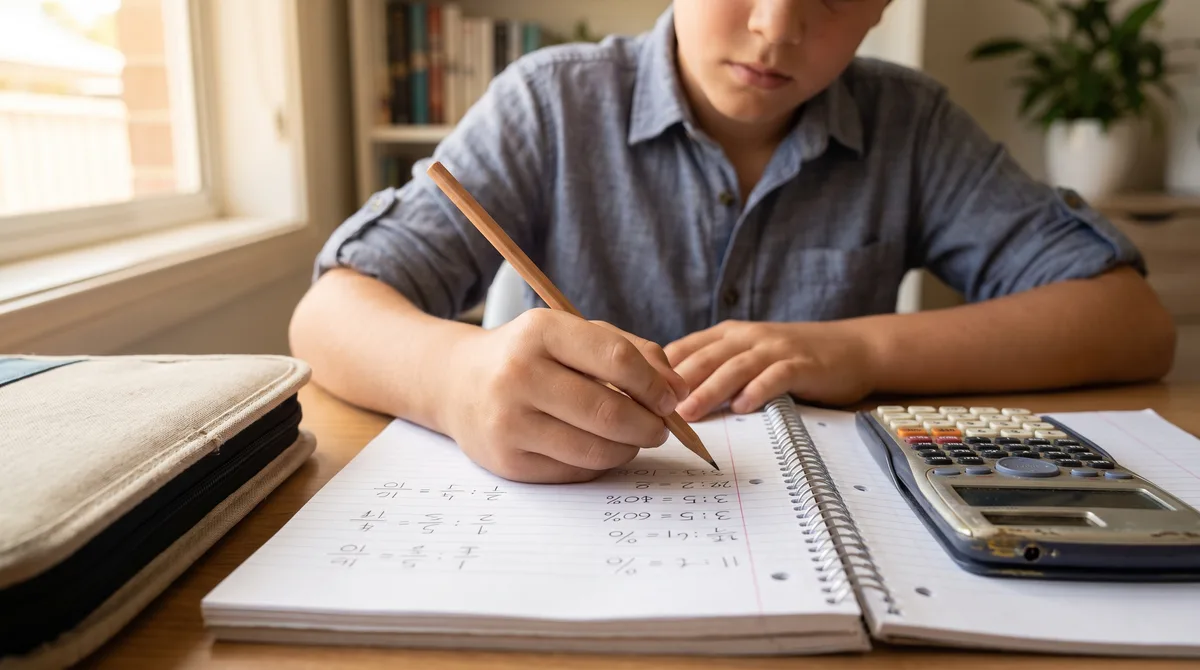
What Your Child Will Tackle in 6th Grade
Knowing what's ahead shows why the checklist matters. Over the year, your sixth-grader will work on:
- Ratios, rates, and unit rates — comparing quantities, and the single biggest topic of the year.
- Percentages — introduced formally, and treated as a rate per 100 rather than a separate trick to memorize.
- Dividing fractions by fractions — the last piece of the fraction puzzle.
- Negative numbers — the number line extends left of zero for the first time, and students learn that 3 and -3 are opposites.
- Expressions and one-step equations — letters standing in for numbers, which is the doorway into pre-algebra in seventh and eighth grade.
- Area, surface area, and volume — plus plotting points in all four quadrants and reading basic statistics like mean and median.
The Non-Math Half of the Jump
Plenty of sixth-grade math trouble isn't really about math. With several teachers and no single adult watching the whole picture, these habits carry real weight:
- Write everything down. A planner or a phone reminder — the method matters less than doing it every day until it's automatic.
- Keep math in one place. One notebook, one folder. Loose worksheets are where homework goes to disappear.
- Ask before it snowballs. Middle school teachers rarely notice quiet confusion. Practise the actual words: "I didn't understand today's example, can you go over it?"
- Check the work, not just the answer. Rereading two steps takes thirty seconds and catches most careless mistakes.
For a game plan that works across every grade, see our five ways to set your child up for a strong year in math.
Don't Let a 5th Grade Gap Follow Them Up
Sixth grade is unforgiving about fractions and decimals, because it uses them constantly as tools rather than teaching them from scratch. If your child finished fifth grade shaky on either, the weeks before school are the cheapest possible time to fix it — our 5th grade math checklist is a quick way to find out exactly what's missing.
The transition itself is also a good reason not to wait and see. A student adjusting to new teachers, a new building, and new expectations has less spare capacity to absorb a math gap on top. Getting the fundamentals steady beforehand keeps the jump to one thing instead of two.
At Elkhawarizmy Academy, our 6th grade math tutoring works on exactly these skills — the fraction and decimal fluency sixth grade assumes, and the organization it quietly demands. The first 1-on-1 lesson is completely free — book a trial and start the year knowing precisely where your child stands.
Try Your First Math Lesson Free
See how 1-on-1 online math tutoring can change everything for your child. No credit card required.
Book a Free TrialKeep Reading
Is Your Child Ready for 2nd Grade Math? A Back-to-School Checklist
What your child needs before 2nd grade math — why tens and ones decide the year, plus six quick checks you can run at the kitchen table.
Read4th Grade Math: What Your Child Should Know Before Day One
The 4th grade math skills your child needs on day one — seven kitchen-table checks, the exact question to ask for each, and what each answer tells you.
Read