
Multiplication Facts: The Only 15 Your Child Has to Memorize
A multiplication chart has 100 squares, but only 15 multiplication facts are truly hard. See the list, the teaching order, and what research says.
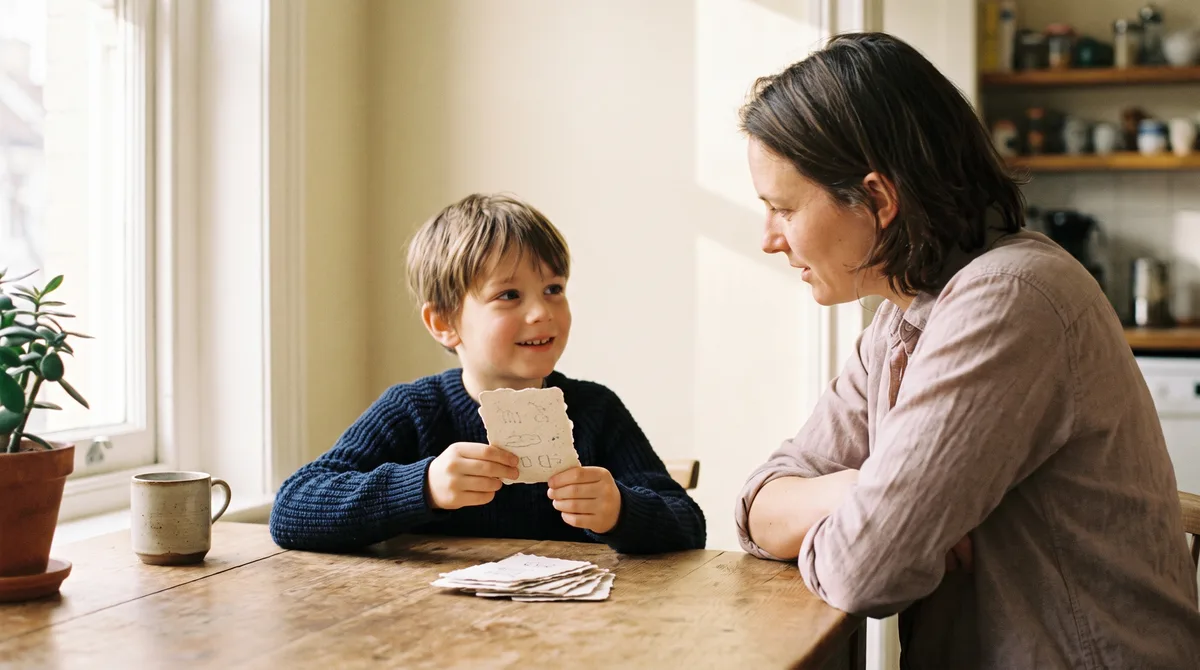
Somewhere around fourth grade, a lot of parents notice the same thing. Their child can work through long multiplication, can explain what multiplication means, can talk about groups and arrays quite happily — and still stops, goes quiet, and counts on their fingers to get 6 × 7.
It is one of the most common things we see, and it is almost never a sign that a child is bad at math. It is a sign that the multiplication facts never became automatic, and that everything built on top of them now costs more effort than it should.
The good news is that the job is much smaller than the wall chart makes it look. There are a hundred squares on a standard multiplication chart. Your child has to memorize fifteen of them.
What "Knowing" a Multiplication Fact Actually Means
This is worth pinning down, because "knows their multiplication facts" gets used to mean two very different things. There is a child who can arrive at 6 × 7, and a child who simply knows it. Only the second one counts.
The standard is more specific than most parents realize. Under the third-grade math standard used across California and most states, students should "fluently multiply and divide within 100," and by the end of Grade 3, know from memory all products of two one-digit numbers. Not derive them. Know them. So if your child is starting fourth grade and still counting up to get there, they are not slightly behind on a nice-to-have — they are behind on something the curriculum assumed was finished a year ago.
In practice the test is about three seconds and no visible strategy. Ask 7 × 6, and either the answer arrives or it doesn't. The reason the delay matters so much is that a child who is busy computing 7 × 6 has no attention left over for the actual problem it appeared inside — the long division, the fraction, the word problem. The facts are not the math. They are what frees a child up to do the math.
Quick check: ask six or seven multiplication facts out of order, mixing easy ones in with 6 × 8 and 7 × 4, and watch rather than listen. Lips moving, fingers under the table, eyes going up and to the side, or a pause that stretches past about three seconds all mean the same thing — that fact is being rebuilt each time rather than recalled. Getting the right answer slowly is the result you are looking for, not the one to be reassured by.
Only 15 Multiplication Facts Are Actually Hard
Start with the full chart — ten rows, ten columns, a hundred facts — and then start crossing things off.
- Order doesn't matter, so half are duplicates. 3 × 7 and 7 × 3 are the same fact learned once. That takes 100 down to 55.
- The 1s are not really facts. 1 × 8 is just 8. Down to 45.
- The 10s are a rule. Add a zero. Down to 36.
- The 2s are doubling — something your child could do before multiplication was ever introduced. Down to 28.
- The 5s come free with skip counting, and any child who can read a clock face already has them. Down to 21.
- The 9s have a pattern. The digits of every answer add to nine, and there is a reliable finger trick. Down to 15.
What survives is every pair you can make from just five numbers — 3, 4, 6, 7 and 8:
3×3 · 3×4 · 3×6 · 3×7 · 3×8 · 4×4 · 4×6 · 4×7 · 4×8 · 6×6 · 6×7 · 6×8 · 7×7 · 7×8 · 8×8
| × | 1 | 2 | 3 | 4 | 5 | 6 | 7 | 8 | 9 | 10 |
|---|---|---|---|---|---|---|---|---|---|---|
| 1 | 1 | 2 | 3 | 4 | 5 | 6 | 7 | 8 | 9 | 10 |
| 2 | 2 | 4 | 6 | 8 | 10 | 12 | 14 | 16 | 18 | 20 |
| 3 | 3 | 6 | 9 | 12 | 15 | 18 | 21 | 24 | 27 | 30 |
| 4 | 4 | 8 | 12 | 16 | 20 | 24 | 28 | 32 | 36 | 40 |
| 5 | 5 | 10 | 15 | 20 | 25 | 30 | 35 | 40 | 45 | 50 |
| 6 | 6 | 12 | 18 | 24 | 30 | 36 | 42 | 48 | 54 | 60 |
| 7 | 7 | 14 | 21 | 28 | 35 | 42 | 49 | 56 | 63 | 70 |
| 8 | 8 | 16 | 24 | 32 | 40 | 48 | 56 | 64 | 72 | 80 |
| 9 | 9 | 18 | 27 | 36 | 45 | 54 | 63 | 72 | 81 | 90 |
| 10 | 10 | 20 | 30 | 40 | 50 | 60 | 70 | 80 | 90 | 100 |
Fifteen facts. At three new facts a week, that is five weeks of five-minute sessions — and most children are already solid on several of them before you start. This is the single most useful thing to tell a child who has decided the times tables are impossibly big: they are not learning a hundred things, they are learning fifteen.
One honest caveat. This is not a claim that the other eighty-five squares don't matter — they absolutely do, and they still need to be fast. The claim is narrower and more useful than that: those you get from a rule or a pattern your child already owns, so they don't need to be drilled one at a time. Only these fifteen have no shortcut.
Teach Them in This Order
The order above is not just a way of counting down — it is the order to teach the multiplication facts in, and the reason is motivational as much as mathematical. Every layer you finish visibly shrinks the chart, so a child sees progress early instead of grinding away at the hard part first and concluding they are no good at this.
- 10s, then 2s. Both are usually already there. Start here precisely because it is easy — the point is to fill in a lot of chart quickly.
- 5s. Skip counting, and the clock face as a backup.
- 9s. Teach the digit-sum pattern rather than the answers.
- The squares — 3×3, 4×4, 6×6, 7×7, 8×8. Five of the fifteen, and children tend to find them satisfying and easy to remember.
- The remaining ten, easiest factor first: the 3s, then the 4s, then 6, 7 and 8 against each other.
Expect 6 × 7 and 7 × 8 to be the last two to stick. In our sessions they almost always are, in children who otherwise have the whole chart. It is not a warning sign, it is just where the pile ends. If you want the ground underneath all of this checked first, the third-grade readiness checklist covers whether a child genuinely understands equal groups before any of it gets memorized.
The Division Facts Come Free
This is worth knowing before you start, because it roughly doubles the payoff. The third-grade standard asks for multiplication and division together, and it spells out why they belong in one sentence: a child who knows that 8 × 5 = 40 also knows that 40 ÷ 5 = 8. It is the same fact read backwards.
So the fifteen multiplication facts are not really fifteen facts — each one is a small family. Once 6 × 7 = 42 is automatic, 42 ÷ 7 and 42 ÷ 6 are automatic too, provided somebody points it out. Plenty of children never make that connection on their own and end up learning the division facts all over again from scratch a year later.
Preventing it takes about ten seconds. When a card comes up, occasionally ask the question the other way round — "and what's 42 divided by 6?" That one habit turns a multiplication deck into a division deck at no extra cost, and it is the cheapest thing in this entire article.
Practice That Works: Recall, Not Recite
Nearly every parent who sets out to teach the multiplication facts reaches for the same two tools — the chart on the fridge, and reciting the tables in order out loud. Reciting is the one to drop, and there is a clean experiment on exactly this.
A 2023 study in Applied Cognitive Psychology ran the two approaches against each other in ordinary elementary classrooms: one group practiced with flashcards, pulling each answer out of memory, while the other chanted and re-read the tables. The flashcard group came out ahead on both accuracy and speed — not only five minutes afterwards, but again a week later.
The difference is that chanting lets a child ride the rhythm of the sequence. They can say the whole five times table beautifully and still stall on 5 × 7 out of order, because what they memorized was a song, not fifteen separate facts. Retrieval is harder in the moment, and that difficulty is doing the work.

What that looks like at the kitchen table:
- Keep the deck small. Five or six cards, not fifty. Cards your child already knows cold should come out of the deck.
- Answer before flipping, always. A guess counts. Looking first does not.
- Five minutes, most days. Short and frequent beats a long Sunday session, because each separate session is another retrieval.
- Put the missed cards back in. A fact your child got wrong should reappear two or three cards later, not tomorrow.
If a deck of cards is a fight in your house, the same retrieval happens inside plenty of games — there are several in our math activities that use no worksheets.
Should You Use a Timer?
This is the question parents actually ask, and the honest answer is more nuanced than either camp admits. You have probably encountered the strong version of the advice: timed drills cause math anxiety, so never time a child. It is repeated confidently almost everywhere, and the evidence behind it is thinner than its confidence suggests.
A 2024 study in the Journal of School Psychology gave 113 fourth- and fifth-graders a series of math tasks, some timed and some not, and measured their anxiety before and after. Timing the tasks produced no statistically significant difference in how anxious the students reported feeling.
So the clock is not the villain. What genuinely rattles children is being tested on material they have not learned yet — and a timed quiz on unlearned facts is exactly that, which is probably why the two got tangled together in the first place. The practical rule that follows is simple:
- While a fact is still being learned, no timer. Retrieval needs room.
- Once the deck is solid, a timer is fine and often fun — as a game against their own previous best, never against a sibling or a classmate.
The distinction to hold onto is that speed is evidence of mastery, not the route to it. Time the victory lap, not the learning.
When It Turns Into a Fight
Multiplication practice goes wrong in predictable ways, and almost all of them are about timing and audience rather than method.
- Not straight after a homework meltdown, and not at bedtime. A tired child cannot retrieve, and the failure teaches them the wrong lesson about themselves.
- Never in front of a sibling — especially a younger one who happens to be quicker.
- Praise the recall, not the speed. "You got that one without counting" names the thing that actually improved.
- Stop while it is still going well. Four good minutes is a better session than ten that end in tears, and it makes tomorrow easier to start.
When It Isn't Really About the Facts
Sometimes a child practices faithfully for months and the multiplication facts still won't hold. When that happens, more drilling is rarely the answer, and there are usually one of three things going on underneath.
Multiplication was never grounded. If a child cannot show you 3 × 4 with objects, they are memorizing noise. Fixing the concept first often makes the memorizing suddenly work. Or the working memory is genuinely stretched — some children need many more exposures than a classroom can give, and that is a pacing problem, not an ability one. Or the child has decided they are bad at math, and is avoiding the practice in small invisible ways. That last one is the most common in the students who come to us, and it is the reason we start with what a child can do.
This is also where gaps stop being local. Automatic facts are the floor under long division, under fractions, and under everything in the jump to middle school — and they are behind a good share of the struggles that surface in fourth grade. If you have been at this a while and it isn't landing, a free trial lesson is a straightforward way to find out which of the three it is. A teacher can usually tell within one session.
Start With Five Minutes
Print the chart, shade in the 10s, 2s, 5s and 9s, and let your child see how little is left. Then build a deck of five cards from the fifteen and spend five minutes on it tomorrow. Learning the multiplication facts is genuinely a few weeks of small sessions, and it buys back years of arithmetic that would otherwise cost your child more effort than it costs everyone else in the room.
And if your child is currently convinced they are hopeless at this, the fifteen-fact version of the chart is worth showing them for that reason alone. A hundred squares looks like a verdict. Fifteen looks like a to-do list.
For where this sits in the wider picture, see our guide to setting your child up for a strong year in math.
Try Your First Math Lesson Free
See how 1-on-1 online math tutoring can change everything for your child. No credit card required.
Book a Free TrialKeep Reading
Math Word Problem Keywords: The Strategy Most Kids Are Taught Doesn't Work
Most kids are taught to hunt for keywords in math word problems. Research says it fails on 9 of 10 multi-step problems. Here's what works instead.
ReadHow to Help Your Child Master Fractions: A Parent's Guide
Fractions are where many kids start to struggle with math. 5 proven, parent-friendly strategies to help your child master fractions with confidence.
Read