
Math Word Problem Keywords: The Strategy Most Kids Are Taught Doesn't Work
Most kids are taught to hunt for keywords in math word problems. Research says it fails on 9 of 10 multi-step problems. Here's what works instead.

Your child can work out 24 ÷ 6 without blinking. Then the same question arrives wrapped in a sentence about cupcakes and six friends, and they stop dead — or worse, they write down 30, because the sentence contained the word "more."
Math word problems are where a lot of otherwise capable students come unstuck, and the usual explanations — they rushed, they didn't read carefully, they need to slow down — don't help much, because none of them say what to actually do differently.
There is something to do differently. It starts with the uncomfortable fact that the most widely taught strategy for word problems — hunting for keywords in word problems, the anchor chart on nearly every classroom wall — has been studied, and it doesn't work.
First, Find Out Which of Three Things Is Failing
"Bad at word problems" isn't a diagnosis. Math word problems ask three separate skills to fire in sequence, and the whole thing fails if any one of them misses. You can find out which in about five minutes at the kitchen table.
- Read the problem aloud to them. If they can suddenly solve it, the issue is reading — decoding the sentence, not the math. That is a reading problem wearing a math costume, and practicing more word problems will not fix it.
- If that doesn't help, hand them the bare calculation. Write "24 ÷ 6" and ask for the answer. If that stalls too, the arithmetic isn't secure yet, and the word problem never had a chance.
- If they read it fine and can compute it fine, you've found it. The break is in the middle step — turning a story into a number sentence. This is translation, and it is the actual skill word problems are designed to test.
Most children who "struggle with word problems" are stuck at step three. It's worth knowing that, because steps one and two have obvious fixes, and step three is where the rest of this article lives.
The Keyword List — and Why It Fails
Nearly every worksheet, anchor chart and homework-help page for math word problems teaches some version of the same rule: hunt for the signal word. Children are given index cards and posters mapping words to operations, and it feels like a system. Here are the keywords in word problems as they usually appear on that chart — and, in the last column, the operation each one actually needs in a problem you could hand a child this afternoon.
| Cue word | Taught to mean | Sometimes needs |
|---|---|---|
| altogether | add | subtract |
| in all | add | divide |
| more | add | subtract |
| left | subtract | add |
| fewer | subtract | add |
| each | multiply | divide |
| total | add | divide |
| times | multiply | divide |
Three of those, worked through, because the pattern is easier to see than to describe. Maya and Sam have 12 marbles altogether. Maya has 5. How many does Sam have? The word is altogether and the answer is 7, by subtraction. Maya gave away 5 stickers and has 7 left. How many did she start with? The word is left and the answer is 12, by addition. There are 20 seats in all, in 4 equal rows. How many seats per row? The words are in all and the answer is 5, by division.
None of those is a trick question. They are ordinary problem shapes a child meets in third and fourth grade, and in each one the cue word points confidently at the wrong operation. That is the trouble with teaching keywords in word problems: the rule is not merely incomplete, it is actively wrong often enough to be worse than no rule.
It has been measured. A 2022 study in The Elementary School Journal went through 747 items from high-stakes assessments and analysed 690 word problems to ask a simple question: if a child followed the keyword rule, how often would they get the right answer? On single-step problems, fewer than half the time. On multi-step problems, fewer than one in ten. The authors' conclusion was blunt — keywords are an ineffective strategy, and teaching them should stop.
A more recent study shows what that looks like in a real classroom. Researchers writing in Learning Disability Quarterly in 2026 gave 112 third-graders four problems that all contained the word "more." On the two where "more" really did mean add, accuracy ran between 84 and 100 percent. On the two where it didn't, accuracy fell to somewhere between 35 and 82 percent. And among the students already struggling in math, 39 percent added on all four problems— they saw the word, chose the operation, and never read the rest.
That is the real damage. The keyword habit doesn't just produce wrong answers; it teaches a child that reading the problem is optional. It works often enough on easy problems to feel reliable, then collapses precisely when problems get harder — which is exactly when a parent starts to worry.
What to Teach Instead: Name the Problem Type
The alternative that holds up is almost the opposite instinct. Instead of scanning for a word, your child works out what kind of situation the problem describes. Nearly all math word problems in elementary school are one of a small number of shapes, and once a child can name the shape, the operation follows from the structure rather than from vocabulary.
This is the approach behind schema-based instruction, which has a genuine evidence base for helping students who find word problems hard. Stripped of the jargon, it is four shapes:
Total
How many altogether?
Two or more parts combine into a whole. Nothing changes and nothing is being compared — the parts simply sit together.
Maya has 4 red marbles and 7 blue ones. How many marbles does she have?
Difference
How many more, or how many fewer?
Two amounts sit side by side and get compared. Nothing is combined, and neither amount changes.
Maya has 12 marbles. Sam has 5. How many more does Maya have?
Change
How many are there now?
One amount grows or shrinks over time. There is a before and an after.
Maya had 12 marbles and gave 5 to Sam. How many does she have now?
Equal Groups
How many in all, or how many in each group?
The same amount, repeated some number of times.
Maya has 6 bags with 4 marbles in each. How many marbles altogether?
A fifth kind — multistep — is simply two of these stacked, and it is where keyword-hunting fails hardest, because a multistep problem may contain signal words pointing at two different operations.
The routine to practice is short enough to say out loud every time: read the whole problem, underline the question, name the type, then choose the operation. Notice that picking the operation comes last. That ordering is the entire point.
The Problem That Breaks the Rule
Try this one on your child:
Maya has 12 marbles. She has 5 more than Sam. How many marbles does Sam have?
A child running the keyword rule sees more, adds, and answers 17. The correct answer is 7. Nothing about the problem is difficult — the arithmetic is 12 − 5 — but the word "more" is describing a comparison between two people, not an instruction to combine anything.
Researchers call these inconsistent problems, and they are the exact point where the keyword habit stops being a harmless shortcut. They are not rare trick questions, either — inconsistent phrasing is one of the standard ways math word problems check whether a child understood the situation or merely scanned it. Ask the question by type instead — is anything being combined? is anything changing? or are two amounts being compared? — and it resolves immediately. Two amounts, side by side, one described relative to the other. That's a Difference problem, and Difference problems are solved by subtracting whether or not the word "more" shows up.
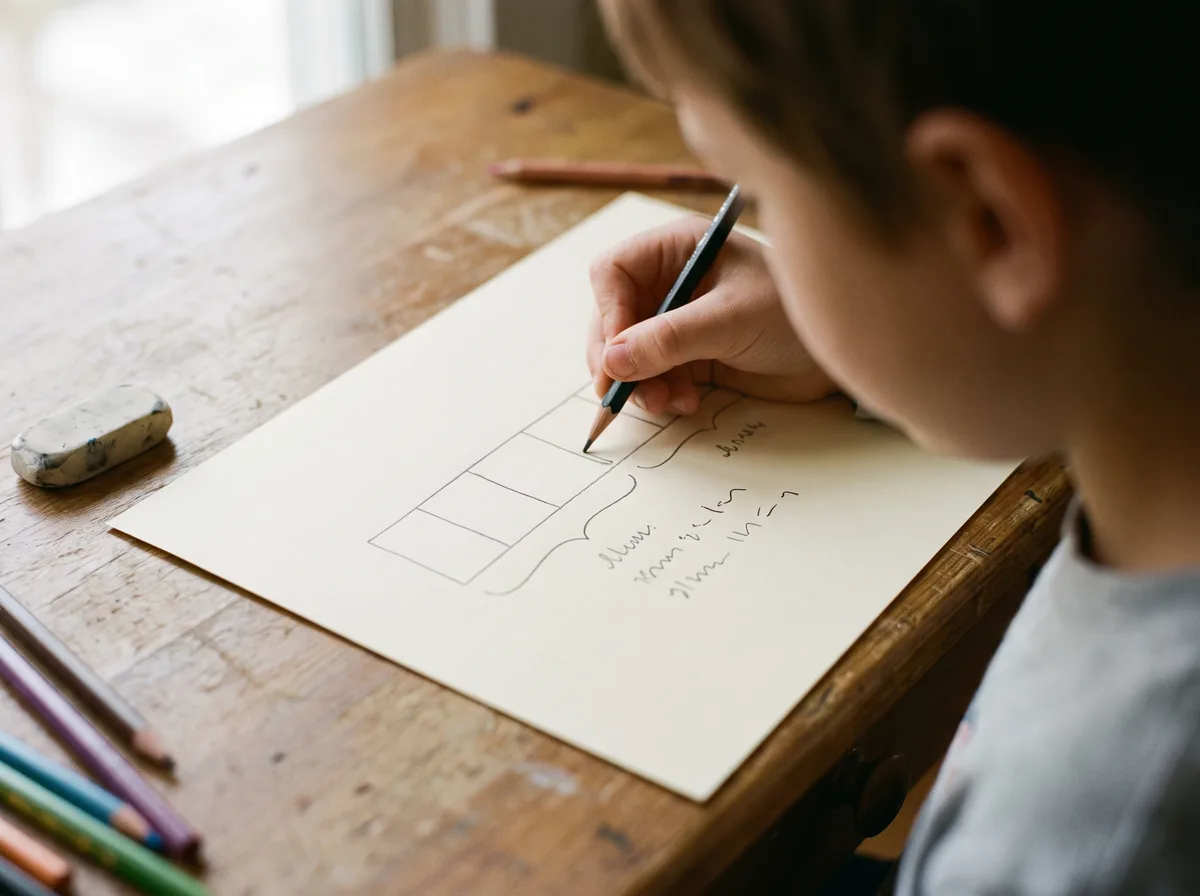
If your child answers 17, don't correct the arithmetic. Ask them to draw it — two bars, one longer than the other. Almost every child fixes it themselves the moment they see the shape.
Where It Gets Genuinely Hard: Two-Step Problems
Remember that the keyword strategy scored under 50 percent on single-step problems but under 10 percent on multi-step ones. That collapse is worth understanding, because it explains the whole thing.
A keyword can tell you an operation. It can never tell you which numbers to use it on. In a one-step problem there are only two numbers, so the gap doesn't show. Give a child this instead:
Maya buys 6 packs of markers with 8 markers in each pack. She gives 15 markers to her brother. How many does she have left?
The word "left" does correctly suggest subtracting. It says nothing about subtracting 15 from what — and 6, 8 and 15 are all sitting right there. A child working from signal words will often produce 8 − 15, or subtract before multiplying, or simply answer 48 and stop, because the first calculation felt like an answer.
Naming the types handles it. This is Equal Groups (6 packs of 8, so 48) followed by Change (48 take away 15, so 33). The useful prompt is: "what do you need to work out before you can answer the question?" That hidden first question is what multi-step math word problems are really testing.
Two-step problems typically appear in third grade and become routine by fourth. By middle school they are most of the paper — the ratio and rate questions in sixth grade are nearly all multi-step. A child who reaches that point still hunting for signal words has been set up to fail by a habit that looked like it was working for years.
How to Help Without Doing It for Them
The hardest part of helping with math word problems is that the useful moves feel like doing less, not more.
- Ask "what kind of problem is this?" before anything else. Not "what do you think you should do?" — that invites a guess at the operation, which is the habit you're replacing.
- Make them cover the numbers and retell the story. If they can't say what's happening without the numbers, no strategy will save them.
- Ask for a drawing before an answer. Boxes and braces, not art. The drawing is the thinking.
- When they're wrong, ask rather than tell. "Read me the part that made you add" surfaces the keyword habit in about ten seconds, and lets them hear it.
- Estimate first. "Roughly, should the answer be bigger or smaller than 12?" catches keyword errors before the arithmetic even starts.
When It Isn't the Word Problems
Sometimes math word problems are the symptom rather than the illness, and step two of the diagnostic above is what reveals it. A child whose multiplication and division facts aren't yet automatic is spending most of their working memory computing, which leaves nothing for holding the story in mind. The word problem looks like the difficulty, but it is only where the shortage becomes visible — which is why getting the multiplication facts automatic so often improves word problems without a single word problem being practiced.
Reading level is the other common culprit, and it tends to show up in third and fourth grade when problems get wordier — one of the struggles that surfaces in fourth grade. A child reading a year below grade level will look like they have a math problem right up until somebody reads the question out loud to them.
If you've worked through the three-step check and still can't tell where it's breaking, that is a reasonable moment to get another pair of eyes on it. A free trial lesson with an online math tutor is usually enough for a teacher to watch a child work and say which of the three it is — and which grade's material to go back to, if the gap turns out to sit further back than this year.
Start With One Question
You don't need a program. For the next week, when math word problems come up, ask one question before anything else: what kind of problem is this? Combining, changing, comparing, or equal groups. Let your child answer that before they touch a pencil.
It will feel slower for a few days. Then it stops being slower, because a child who knows what kind of problem they're looking at has stopped guessing — and the word "more" goes back to being an ordinary word rather than an instruction.
Try Your First Math Lesson Free
See how 1-on-1 online math tutoring can change everything for your child. No credit card required.
Book a Free TrialKeep Reading
Multiplication Facts: The Only 15 Your Child Has to Memorize
A multiplication chart has 100 squares, but only 15 multiplication facts are truly hard. See the list, the teaching order, and what research says.
ReadHow to Help Your Child Master Fractions: A Parent's Guide
Fractions are where many kids start to struggle with math. 5 proven, parent-friendly strategies to help your child master fractions with confidence.
Read