
Is Your Child Ready for 1st Grade Math? A Back-to-School Checklist
What your child actually needs before 1st grade math — the two skills that predict the year, plus a five-minute check you can run at home.
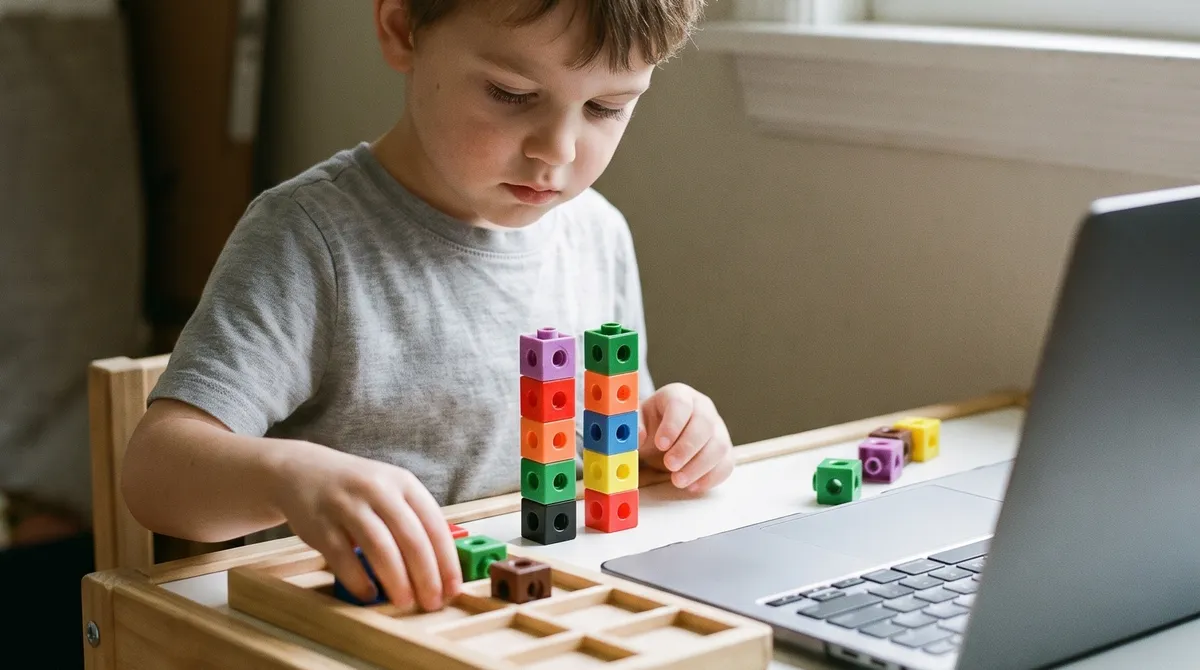
First grade rarely produces a bad report card. That is exactly what makes 1st grade math readiness so easy to miss — a child who is behind at five or six is not failing anything. They are simply slower than the child at the next table, and they usually notice that before any adult does.
The reassuring part is that readiness at this age comes down to a very short list. Not the twenty-item checklist you will find on most sites, half of which is reading and shoe-tying. Two skills do most of the work, and you can check both of them at the kitchen table in about five minutes.
The Two Skills That Decide First Grade
Most readiness checklists hand you eight or ten math items in a flat list, as though counting to twenty and naming a triangle carry the same weight. In our experience they are nowhere close. Two things predict how the year goes.
Counting on from a number that isn't one. Ask what comes three after seven. A ready child says eight, nine, ten. A child who is not ready goes back to one and counts all the way up. That is not a stylistic difference — it is a kindergarten standard in its own right. The Common Core State Standards Initiative words it as K.CC.A.2: “Count forward beginning from a given number within the known sequence (instead of having to begin at 1).”
Seeing a small amount without counting it. Roll a die. A ready child says “four” — they see it. A child who is not ready touches each dot in turn. Numbers have not yet become amounts to them; they are still a recital, a song with the words in a fixed order.
Everything first grade does sits on those two. Adding within twenty by counting on, making ten, taking a teen number apart into ten and some more — all of it assumes a child can start somewhere other than one, and can hold a small quantity in mind without rebuilding it from scratch. And the stakes are not small: pooling six long-term datasets, Duncan and colleagues' 2007 study in Developmental Psychology found school-entry math skills to be the strongest predictor of later academic achievement — ahead of early reading, and ahead of attention.
The Back-to-School Readiness Checklist
This is 1st grade math readiness in full — six skills, listed in the order we would check them rather than the order a curriculum would teach them. That ordering is the point: the first two are what August is for, and the last two will largely sort themselves out in class.
1. Counting On From Any Number
Why it matters: It is the gateway skill. A child who must restart at one is doing far more work than the answer requires, on every single problem, all year.
Quick check: “Start at six and count up four.” Watch where they begin. If they say “one, two, three…” under their breath, this is the thing to work on, and it responds quickly to practice.
2. Seeing Small Amounts Without Counting
Why it matters: Recognising three or four at a glance is what turns a number from a word into a quantity. Without it, arithmetic is counting with extra steps.
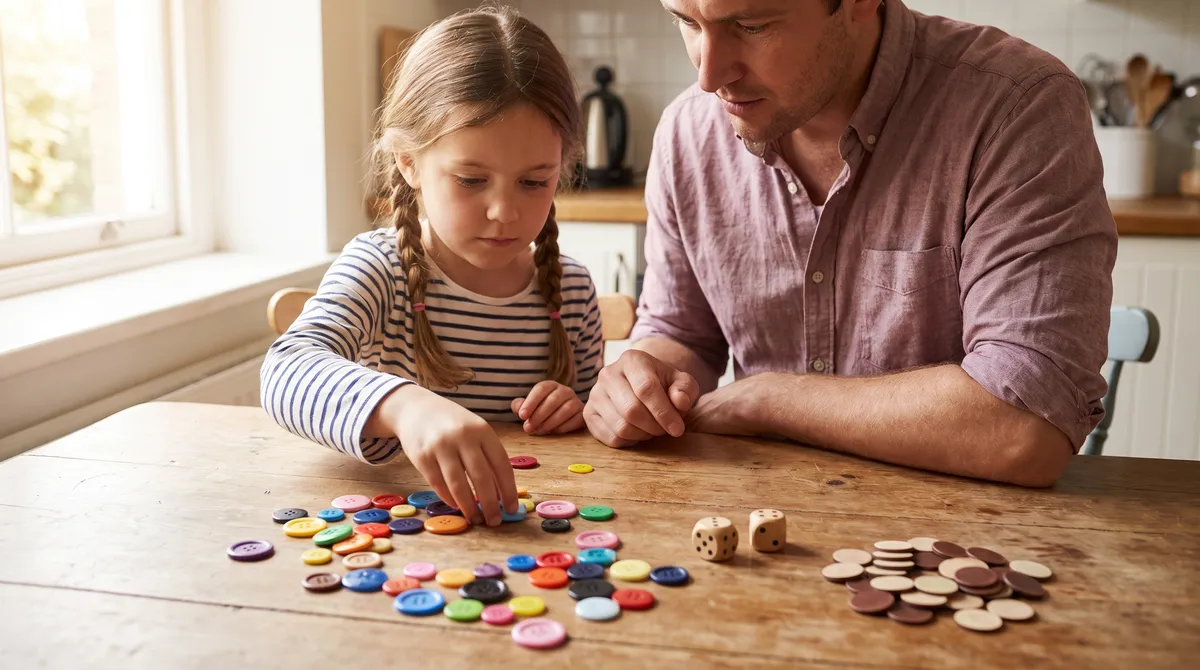
Quick check: Drop four or five buttons on the table, cover them, uncover them for a second, cover them again. Ask how many. You are watching for an answer, not a count.
3. Number Bonds to Ten
Why it matters: Nearly every strategy first grade teaches — make ten, bridge through ten, doubles and near-doubles — assumes a child already knows that six needs four, that seven needs three.
Quick check: Hold up seven fingers. “How many more to make ten?” Then try it with four, with eight. Instant answers mean this is done; counting up the remaining fingers means it is not.
4. Adding and Subtracting Within Five, Without a Pause
Why it matters: Kindergarten aims for fluency within five, and first grade builds on it immediately. Small sums are where the habit of recalling rather than reconstructing gets set.
Quick check: 3 + 2, 5 − 1, 4 + 1. You want these to come back in about a second. Correct-but-slow counts as not yet — see below for why.
5. Teen Numbers as Ten and Some More
Why it matters: Fourteen is not a new number to memorise, it is ten and four. A child who sees teens that way walks into place value already halfway there.
Quick check: “Show me thirteen with these.” Give them counters. Building a group of ten first is the answer you want; counting out thirteen singles is fine for now but worth a little attention.
6. Saying Which of Two Numbers Is Bigger — and Why
Why it matters: Comparison is the first piece of mathematical reasoning most children do. The “why” matters more than the answer.
Quick check: “Which is more, eight or five? How do you know?” Any reason grounded in amount — “because eight is further along”, “because there would be three left over” — is a good sign.
A Five-Minute Check at the Kitchen Table
Run the six questions above in one sitting, over a snack, with no announcement that it is a test. The answers matter less than three things you are watching for while they work.
Does the count restart at one? This is the single most useful thing you will learn in the five minutes. A child who resets to one on most questions is telling you where to spend August, and it is the item that improves fastest.
Do the fingers come out — and when? Fingers are how six-year-olds are supposed to start, so their presence proves nothing. What matters is whether they appear for 3 + 2. Fingers on the small sums, this close to the school year, means the small sums are still being worked out rather than known.
How long is the pause before the answer? Count it silently. Under a second is recall. Three or four seconds, even with a correct answer, is reconstruction — your child is rebuilding the fact each time they need it.
Two or three items shaky is completely normal in August and is exactly what the next few weeks are for. If five or six are shaky, or if every answer is arriving by counting, that is worth acting on before term rather than after the first parent evening.
What Your Child Will Actually Learn in 1st Grade
Knowing what is coming makes the checklist make sense. Across the year your first grader is expected to:
- Add and subtract within 20. The standard — 1.OA.C.6 — asks them to “add and subtract within 20, demonstrating fluency for addition and subtraction within 10”. Fluency, not accuracy, is the word doing the work there.
- Count to 120 from any starting number — and read and write those numerals, not just say them.
- Understand tens and ones. Place value proper, where 43 is four tens and three ones rather than the digits four and three side by side.
- Tell time to the hour and half hour, on an analog clock as well as a digital one.
- Name, sort and build shapes, and start describing them by their attributes rather than by what they look like.
Notice how much of that assumes the two skills at the top of this article are already in place. None of it teaches them.
Right, But Slow — the Signal Most Parents Miss
Almost every readiness guide treats these skills as pass or fail: your child can add within five, or they cannot. The more common situation is the one in between, and it is the one that goes unnoticed for years — the child who gets everything right, by counting, a few seconds behind everyone else.
Nothing about that looks like a problem in August. It is not wrong, it is not distressing, and no teacher will raise it. But arithmetic that has to be rebuilt each time it is used takes up room, and it takes that room from whatever the lesson is actually about. A child working out 8 + 6 has nothing left over for the idea the teacher is introducing on top of it.
This is why 1st grade math readiness is worth checking on speed rather than on correctness, and why the pause is worth counting. It is also why the same children turn up in our fourth-grade lessons several years later, having quietly paid that tax on every lesson in between, described by everyone as bad at long division.
How to Prep Before the Bell — No Worksheets Needed
Ten focused minutes a day will do more than an hour on a Sunday, and at this age none of it should look like school:
- Count on in the car. “Start at twelve.” Take turns. Start from odd places so one is never the default.
- Play anything with dice. Snakes and ladders does more for recognising four at a glance than any app, because the game gives them a reason to stop counting the dots.
- Make ten out loud. Hands, grapes, socks out of the dryer — “we have six, how many more for ten?”
- Build teens as ten and some. Stack ten of something, then add the rest. It takes thirty seconds and it is the whole idea of place value.
- Stop while it is still fun. The goal is a confident child in September, not a well-drilled one who has learned that numbers mean being tested.
For more in this vein across every age, see our summer math activities that don't look like school and five ways to set your child up for a strong year.
When It's Worth Getting Help
Most children will not need a tutor for any of this, and 1st grade math readiness is not something to lose August over. But first grade is the cheapest time to fix anything. A gap here costs a few weeks; the same gap found in fourth grade costs a term, because by then it is buried under three years of work that depended on it.
We teach these foundations every day, one child at a time — you can read what the year holds and where we start on our 1st grade math tutor page, or see the same checklist a couple of years on for third grade. The first lesson is free: a teacher runs a proper version of the check above and tells you honestly which items are solid — including, quite often, that your child is fine and does not need us. Book a trial and find out before term starts.
Try Your First Math Lesson Free
See how 1-on-1 online math tutoring can change everything for your child. No credit card required.
Book a Free TrialKeep Reading
4th Grade Math: What Your Child Should Know Before Day One
The 4th grade math skills your child needs on day one — seven kitchen-table checks, the exact question to ask for each, and what each answer tells you.
Read5th Grade Math: A Back-to-School Checklist Before Middle School
5th grade is the on-ramp to middle school math. Here's the back-to-school checklist of skills your child should have locked in — and what's coming this year.
Read