
Online 2nd Grade Math Tutor
The year multiplication quietly begins.
Second grade looks like more of first grade — bigger numbers, the same two operations — and that resemblance is what makes it easy to miss. Two things are genuinely new. Regrouping is the first real algorithm a child meets, and equal groups are multiplication arriving a year early under another name. A 2nd grade math tutor spends most of the time on those two.
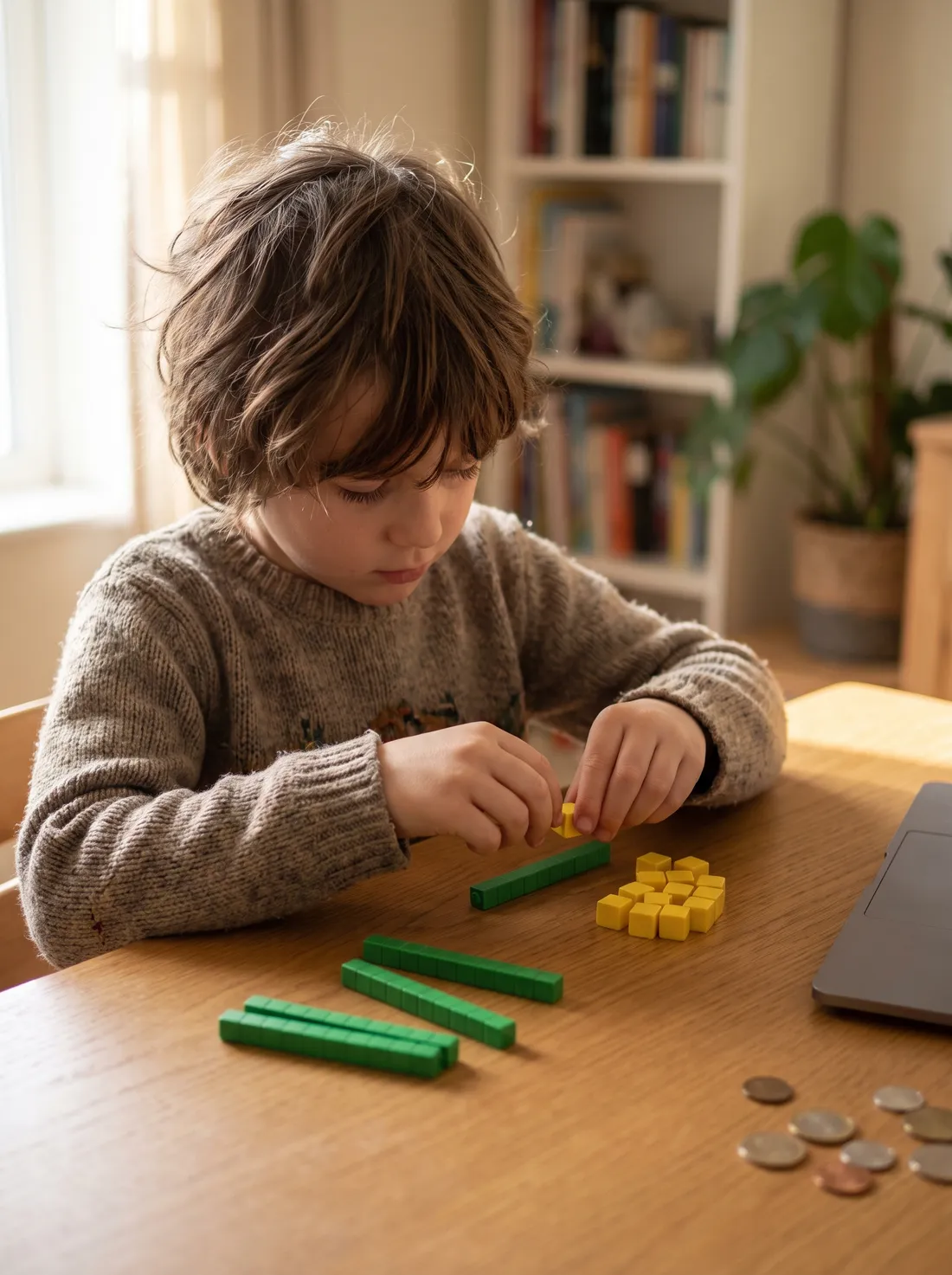
What 2nd Grade Math Covers
- Adding and subtracting within 100, then 1000
- Place value to 1000 — hundreds, tens and ones
- Equal groups and arrays — the groundwork for multiplication
- Money, and telling time to the nearest five minutes
Regrouping is where second grade breaks, and it breaks hardest across zeros — 300 − 148 undoes children who are fine with 342 − 118. The other quiet gap is arrays: they look like a picture-drawing exercise, so they get rushed, and then third-grade multiplication arrives with no foundation under it.
Signs Your 2nd Grader Needs a Math Tutor
Four things you can watch for this week at your own kitchen table, and what each one usually means underneath.
Subtracts the smaller digit from the larger one
For 42 − 18 they write 36, because 8 − 2 = 6. It isn't carelessness — it's a child applying the rule they do have when the rule they need is missing. It is the most common written error in second grade.
Regrouping falls apart across a zero
302 − 148 defeats children who handle 342 − 118 without trouble. Borrowing from a zero takes two moves instead of one, and a procedure learned as a sequence of steps has no second move in it.
Adding within 20 still takes visible effort
That was first grade's job and it doesn't finish itself. A child working out 8 + 7 has nothing left over for the hundreds column sitting above it.
Arrays get drawn, not read
Rows of dots look like a colouring exercise, so they get hurried. But an array is the picture of multiplication, and third grade proceeds as though it is already understood.
Where a 2nd Grade Math Tutor Should Start
What we check first
We check fluency within twenty first — the addition and subtraction facts first grade was meant to make automatic. Second grade's entire workload assumes them, and a child still working out 9 + 6 is spending on that the attention the rest of the problem needs. It is very common to find a capable-looking second grader whose real problem is a first-grade one, and that is good news, because it is quick to fix.
What the first few weeks look like
Regrouping gets taught with the place value made visible: what the ten actually is, where it goes, and why the zero case needs two moves rather than one. Rules learned as steps break the first time the numbers change shape; rules learned as movement between columns don't. Alongside that we build the arrays properly, because a child who can see four rows of six has already started third-grade multiplication, and one who can't will spend next year memorising facts that mean nothing to them.
Free 2nd grade guides: Is Your Child Ready for 3rd Grade Math? A Back-to-School Checklist · Multiplication Facts
Questions Parents of 2nd Graders Ask
The school says my child is meeting standard. Should I still worry?
Meeting standard means keeping pace with what has been taught so far. It doesn't distinguish between facts that are automatic and facts that are merely reachable, and that distinction is invisible on a second-grade report card. It becomes highly visible in fourth grade, when long division needs a fact instantly and there is no time to work one out.
They understand it at home and then get it wrong on the test.
That gap is almost always fluency rather than understanding. At the kitchen table there is time to rebuild the method; under a time limit there isn't. When a child has to reconstruct a procedure each time they use it, the reconstruction is the first thing pressure takes away.
How long before I see a difference?
For a second grader with a fact-fluency gap, usually four to six weeks before the classroom work stops being a fight — though you tend to hear it at home before that, because homework gets quieter first. You get what we covered and how it went in writing every week, so you aren't left guessing.
Start With a Free Lesson
A teacher works with your child for a full lesson, at no cost and with nothing to cancel. Afterwards you get our honest read on where your 2nd grader actually is, what we'd work on first, and what it would cost — in writing, before you decide anything.