
8th Grade Algebra by State: Who Actually Gets to Take Algebra 1
8th grade algebra by state: about 1 in 4 US 8th graders takes Algebra 1, and 741,000 attend a school where none do. Look up your school district.
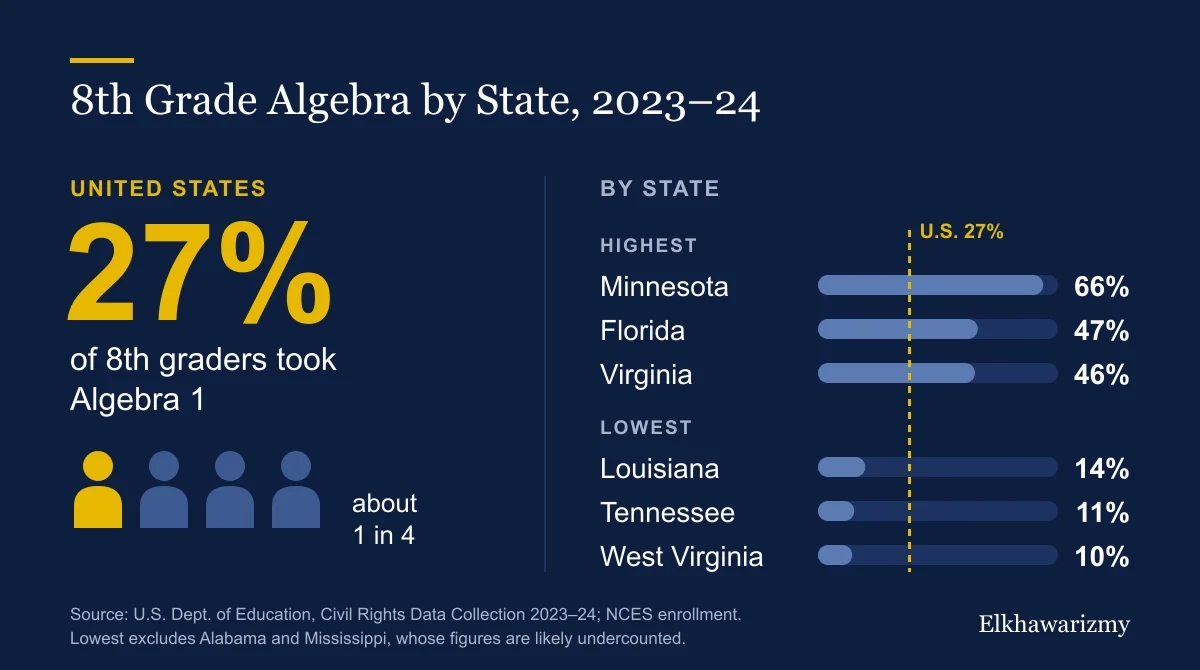
Whether your child gets to take 8th grade algebra depends less on your child than on where you live. In 2023–24, about one in four American eighth graders (26.7%) was taking Algebra 1, or had already taken it in 7th grade. That's from our analysis of federal data covering every public school in the country. In Minnesota the figure was 66%. In West Virginia it was 10%. And roughly 741,000 eighth graders attended a school where not a single 8th grader was enrolled in the course.
If you're deciding whether to push for Algebra 1 in 8th grade, the numbers below show what's normal where you live. You can look up your own district, and the research section covers when taking it early actually helps.
26.7%
of US 8th graders took Algebra 1 in middle school in 2023–24
741,000
8th graders attended a school where no 8th grader was in Algebra 1
6 in 10
schools that teach 8th grade had any 8th graders in Algebra 1
66% vs 10%
Minnesota vs West Virginia, the highest and lowest reliable state figures
8th Grade Algebra by State (2023–24)
The national average hides enormous differences between states. Below is every state plus Washington, D.C., ranked by the share of 8th graders taking Algebra 1. The last column answers a different question: how many 8th graders even attend a school that puts any 8th graders in the course. A low number there means families often have no option at their own school, whatever their child's readiness.
| # | State | 8th graders in Algebra 1, 2023–24 | 2021–22 | At a school that offers it |
|---|---|---|---|---|
| 1 | Minnesota | 65.7% | 64.1% | 86% |
| 2 | Florida | 46.6% | 41.0% | 97% |
| 3 | Virginia | 45.8% | 41.7% | 99% |
| 4 | Maryland | 35.2% | 37.2% | 94% |
| 5 | Idaho | 34.8% | 35.0% | 77% |
| 6 | New York | 34.2% | 33.8% | 92% |
| 7 | Massachusetts | 31.9% | 29.8% | 71% |
| 8 | District of Columbia | 31.8% | 26.4% | 69% |
| 9 | New Jersey | 31.3% | 33.1% | 83% |
| 10 | Texas | 31.0% | 29.7% | 90% |
| 11 | Utah | 30.7% | 29.4% | 62% |
| 12 | Washington | 30.7% | 29.7% | 87% |
| 13 | Pennsylvania | 29.9% | 29.2% | 86% |
| 14 | Colorado | 28.5% | 27.0% | 78% |
| 15 | Illinois | 28.5% | 27.7% | 75% |
| 16 | North Carolina | 28.4% | 25.3% | 93% |
| 17 | Connecticut | 28.2% | 25.3% | 77% |
| 18 | Nebraska | 27.5% | 28.5% | 92% |
| 19 | Nevada | 26.7% | 24.4% | 93% |
| 20 | South Carolina | 26.2% | 24.4% | 96% |
| 21 | Delaware | 23.6% | 26.2% | 69% |
| 22 | Rhode Island | 23.5% | 21.8% | 88% |
| 23 | Hawaii | 23.0% | 18.0% | 89% |
| 24 | Ohio | 22.6% | 22.3% | 86% |
| 25 | Indiana | 22.4% | 22.4% | 91% |
| 26 | Wyoming | 21.7% | 22.6% | 89% |
| 27 | Alaska | 21.2% | 20.9% | 77% |
| 28 | Michigan | 21.2% | 21.4% | 75% |
| 29 | Wisconsin | 21.1% | 19.4% | 74% |
| 30 | Georgia | 21.0% | 24.3% | 84% |
| 31 | Kentucky | 20.7% | 19.3% | 85% |
| 32 | Missouri | 20.5% | 19.9% | 79% |
| 33 | South Dakota | 19.8% | 18.7% | 76% |
| 34 | Montana ‡ | 19.5% | 32.2% | 60% |
| 35 | North Dakota | 19.3% | 18.4% | 75% |
| 36 | Arizona | 18.9% | 19.3% | 72% |
| 37 | Kansas | 18.9% | 18.0% | 76% |
| 38 | Oregon | 18.9% | 18.8% | 66% |
| 39 | New Hampshire | 18.6% | 19.8% | 75% |
| 40 | California | 18.3% | 17.4% | 62% |
| 41 | Iowa | 17.2% | 19.7% | 66% |
| 42 | Maine | 16.5% | 16.7% | 69% |
| 43 | New Mexico | 16.5% | 12.2% | 72% |
| 44 | Oklahoma | 15.3% | 16.3% | 77% |
| 45 | Vermont | 15.3% | 14.1% | 43% |
| 46 | Arkansas | 14.0% | 12.4% | 79% |
| 47 | Louisiana ‡ | 13.8% | 19.1% | 67% |
| 48 | Tennessee | 10.6% | 10.8% | 55% |
| 49 | West Virginia | 10.0% | 8.8% | 60% |
| 50 | Alabama † | 5.5% | 7.1% | 14% |
| 51 | Mississippi † | 4.0% | 4.5% | 21% |
Nationally, the picture barely moved in two years: 25.8% in 2021–22, 26.7% in 2023–24. The share of schools with any 8th graders in Algebra 1 slipped slightly, from 60.6% to 59.4%. Florida (up about 6 points) and Virginia (up about 4) grew the most among large states. Changes of a point or two in either direction are within the range of normal reporting differences.
Why States Are So Far Apart
Some of the gap is policy, and some of it is simply what schools call the course.
Minnesota requires it
Minnesota passed a law in 2006 requiring every 8th grader to take Algebra 1, starting in the 2010–11 school year, and it is the only state that has kept such a policy, The Hechinger Report found. That's why it tops the table. As you'll see below, results there have been mixed.
Some states are pushing more students in automatically
A growing number of states now place strong math students into advanced courses by default instead of waiting for a teacher or parent to ask. North Carolina's law says a student who scores at the top level on the 7th-grade math test must be placed in high school math (NC Math 1) in 8th grade, and can't be removed without a parent's written consent, according to the state education department. Texas, since 2023–24, automatically enrolls 6th graders who scored in the top 40% of the 5th-grade state math test in advanced math, with an option for families to opt out, per the Education Commission of the States. An Education Week analysis counted 22 states that have passed math laws or policies since 2022, 10 of which will require automatic enrollment. Many are too recent to show up in 2023–24 numbers.
Some states teach Algebra 1 under a different name
The federal survey asks schools to count any class that covers Algebra 1 content, even if it's called something else, such as integrated math. Not every school does. Alabama's 2019 course sequence moves most students from Math 8 into Geometry with Data Analysis in 9th grade, and its accelerated middle-school courses are named "Math 7 Accelerated" and "Math 8 Accelerated" rather than Algebra 1 (see Alabama's course pathways). Mississippi offers a "Compacted Grade 8 (with Algebra I)" course (state course list). That's why both states' figures carry a † in the table. Their low numbers likely reflect course labels, not a lack of advanced students.
Find Your School District
Your district can matter more than your state. Montgomery County and Prince George's County in Maryland sit side by side; one put 58% of its 8th graders in Algebra 1, the other 13%. Pick your state, then type your district or city.
Pick a state to see every district with at least 20 eighth graders.
Source: our analysis of the U.S. Department of Education's 2023–24 Civil Rights Data Collection and NCES enrollment counts. Download every district (CSV).
A few things to keep in mind. The figure counts 7th graders already taking Algebra 1, so a district that accelerates many students in 7th grade can show close to (or above) 100%. Small districts swing a lot from year to year, because a handful of students changes the percentage. And a district can have a high average while one of its schools offers nothing, which is why the lookup also shows how many schools enroll any 8th graders in the course.
The 25 largest districts
| District | 8th graders | In Algebra 1 | Schools offering it |
|---|---|---|---|
| Los Angeles Unified, CA | 29,778 | 21.6% | 102 of 144 |
| Miami-Dade County, FL | 25,844 | 50.2% | 173 of 195 |
| City of Chicago SD 299, IL | 23,861 | 30.1% | 252 of 456 |
| Clark County School District, NV | 22,823 | 28.5% | 63 of 75 |
| Broward County, FL | 19,249 | 47.9% | 82 of 96 |
| Hillsborough County, FL | 16,927 | 48.4% | 85 of 99 |
| Orange County, FL | 15,129 | 44.2% | 74 of 86 |
| Palm Beach County, FL | 14,408 | 44.1% | 64 of 79 |
| Gwinnett County, GA | 14,312 | 30.6% | 31 of 35 |
| Fairfax County Public Schools, VA | 13,225 | 65.6% | 26 of 28 |
| Hawaii Department of Education, HI | 12,828 | 23.0% | 52 of 85 |
| Wake County Schools, NC | 12,459 | 50.5% | 41 of 45 |
| Houston ISD, TX | 12,386 | 24.1% | 52 of 60 |
| Montgomery County Public Schools, MD | 12,070 | 58.3% | 40 of 44 |
| Charlotte-Mecklenburg Schools, NC | 10,958 | 37.8% | 48 of 51 |
| Prince George's County Public Schools, MD | 9,844 | 13.4% | 34 of 48 |
| Dallas ISD, TX | 9,357 | 54.8% | 54 of 56 |
| Duval County, FL | 8,980 | 49.2% | 54 of 61 |
| Cypress-Fairbanks ISD, TX | 8,814 | 33.8% | 18 of 20 |
| Polk County, FL | 8,775 | 41.5% | 44 of 51 |
| Cobb County, GA | 8,320 | 22.7% | 27 of 28 |
| Philadelphia City SD, PA | 8,301 | 17.4% | 49 of 126 |
| Baltimore County Public Schools, MD | 8,102 | 35.2% | 27 of 33 |
| Lee County, FL | 7,679 | 47.3% | 32 of 37 |
| Northside ISD, TX | 7,613 | 36.8% | 21 of 26 |
Even among big districts the range is wide. Fairfax County, Virginia, and Montgomery County, Maryland, put more than half their 8th graders in Algebra 1. Los Angeles Unified, Houston and Philadelphia are near or below the national average.
Who Gets a Seat in 8th Grade Algebra
Across all public schools, the share of 8th graders in Algebra 1 differs sharply by race and ethnicity:
Part of that gap is about which schools offer the course at all. A 2025 NWEA study of 162,000 eighth graders in 22 states found that only about 3 in 5 schools offered Algebra 1 by 8th grade, and fewer than half of high-poverty schools did. Our count of every public school lands in the same place: 59.4%.
But placement matters even inside schools that offer it. In the same NWEA study, among students who had scored in the top 20% in 5th grade, 84% of Asian students and 68% of White and Latino students took Algebra in 8th grade, compared with 60% of Black students. A 2026 NWEA report following 55,000 students found that roughly a quarter look ready for Algebra 1 by the end of 7th grade, and that nearly one in four of those ready students still didn't take it in 8th grade.
For parents, the practical point is this: if your child is strong in math, don't assume the placement will happen on its own. Ask.
Does Taking Algebra 1 in 8th Grade Actually Help?
It helps students who are ready, and it can hurt students who aren't. The research is surprisingly consistent on that.
- For students who are ready, it opens doors. A study of several hundred California middle schools that placed students by 7th-grade test scores found that enrolling in 8th-grade algebra raised enrollment in advanced math by 30 percentage points in 9th grade and 16 points in 11th grade, with a small gain in 10th-grade math scores (McEachin, Domina and Penner, 2020). The gains were largest in schools that set a higher bar for placement, which the authors read as a trade-off between opening access and later success.
- Pushing students who aren't ready backfires. When Charlotte-Mecklenburg Schools in North Carolina raised the share of moderately performing students taking 8th-grade algebra from about half to 85%, those students scored lower on the Algebra 1 end-of-course test and were no more likely, or less likely, to pass Geometry and Algebra 2 on schedule (Clotfelter, Ladd and Vigdor, Journal of Human Resources, 2015).
- Timing matters most for strong students. In NWEA's 2026 report, students in the top half of 7th-grade math scores did better in Algebra when they took it in 8th grade rather than 9th. Students in the bottom half did about the same either way, and stayed below the proficiency benchmark in both cases.
- Removing it for everyone didn't close gaps. San Francisco stopped offering Algebra 1 before 9th grade in 2014–15. Participation in AP math initially fell by 15%, mostly in AP Calculus, before other ways to accelerate partly made up the difference, and large racial gaps in advanced math remained (Huffaker, Novicoff and Dee, Educational Researcher, 2025). In 2024, 82% of San Francisco voters backed a measure urging the district to bring it back.
- Requiring it for everyone hasn't paid off either. In Minnesota, the share of students taking calculus rose only from 1.25% to 1.76% between 2009 and 2017, and the state slipped from second to eighth in 8th-grade NAEP math between 2009 and 2022, according to The Hechinger Report's analysis.
The pattern is clear enough to act on: what matters is whether your child is ready, not which grade the course falls in.
How Schools Decide Who Takes 8th Grade Algebra
Placement rules are set by districts, not states (apart from the automatic-enrollment laws above), so they vary a lot. Most combine some of these:
- Your child's score on the 6th- or 7th-grade state math test
- Grades in 6th and 7th grade math
- A placement test given in spring of 7th grade
- A teacher recommendation
- Having taken an accelerated or "compacted" math course in 6th or 7th grade
That last one catches many families out. In a lot of districts the real decision happens in 5th or 6th grade, when students are sorted into an accelerated track that compresses three years of math into two. By the time you ask about 8th grade algebra, the window may already have closed. Our 6th grade math readiness checklist covers what to look for earlier.
Is Your Child Ready for 8th Grade Algebra?
Algebra 1 assumes a set of skills that are supposed to be solid by the end of 7th grade. A child who is ready can usually:
- Add, subtract, multiply and divide fractions and negative numbers without hesitating
- Work comfortably with ratios, rates and percentages
- Write and solve one-step and two-step equations, and explain each step
- Translate a word problem into an expression or equation
- Recall multiplication facts instantly, so they don't use up working memory
If one or two of those are shaky, that's normal and fixable, and it's far better to fix it in 7th grade than to discover it halfway through Algebra 1. We go through each skill in the 6 skills that matter most before pre-algebra. If your child is well ahead of their class, our guide to supporting gifted kids in math is a better fit.
What to Ask Your Child's School
Whether the answer you're expecting is yes or no, these questions get you a straight one:
- Does our middle school offer Algebra 1 (or an equivalent course) in 8th grade?
- How are students placed, and what score or grade qualifies?
- When is the decision made, and is there a placement test? When is it given?
- Can a parent request placement or a review if my child narrowly misses the cutoff?
- Is there a summer bridge course that leads into 8th grade algebra?
- If it isn't offered here, can my child take it at another school or online?
- Will it count for high school credit, and what course follows in 9th grade?
If the honest answer is that your child isn't ready yet, the goal shifts to making sure they're ready for Algebra 1 in 9th grade. That's a completely good path. Many high schools let students double up or take a summer course later if they want to reach calculus.
If your child is right on the edge, a few months of focused one-on-one work in 7th grade can change the placement conversation. That's what we do: online math tutoring for grades 1 through 8, with a teacher who works on the specific gaps. A free trial lesson is an easy way to find out where your child really stands. You can also see how we approach 7th grade and 8th grade math.
How We Calculated These Numbers
We wanted figures any parent, reporter or researcher could check, so here is exactly how they were made.
- Algebra 1 enrollment comes from the U.S. Department of Education's 2023–24 Civil Rights Data Collection, a mandatory survey of every public school and district, released in 2026. Schools report the number of students in grades 7 and 8 enrolled in Algebra 1, including courses that cover Algebra 1 under another name.
- Eighth-grade enrollment comes from the matching year of the NCES Common Core of Data, joined school by school.
- The measure is Algebra 1 students in grades 7–8 divided by the number of 8th graders. Because each student takes Algebra 1 once, this approximates the share of students who take it before high school. It covers 28,487 schools and 3,576,474 eighth graders in the 50 states and D.C., excluding juvenile justice facilities.
- Schools with no Algebra 1 class for grades 7–8 skip the enrollment question on the federal form. We count those as zero, which is what they are.
- We left out 258 schools (under 1% of 8th graders) that reported more Algebra 1 students than all of their 8th graders plus half their 7th graders. That almost always means a school reported its regular grade-level math class as Algebra 1.
- Known limits. The Department of Education adds small random changes to school counts to protect student privacy, which can shift tiny districts by a few points but evens out at state level. Counts for nonbinary students are withheld in the public file. Puerto Rico is not included.
You're welcome to use these figures, with a link back to this page. Download every district as a CSV.
Frequently Asked Questions
What grade do most students take Algebra 1?
Most American students take Algebra 1 in 9th grade. In 2023-24, about 1 in 4 eighth graders (26.7%) took it in middle school, and roughly three out of four students enrolled in Algebra 1 that year were in high school, according to federal Civil Rights Data Collection figures.
Is Algebra 1 in 8th grade considered advanced?
In most states, yes. Algebra 1 is usually a 9th-grade course, so taking it in 8th grade puts a student a year ahead and on track for calculus by 12th grade. Minnesota is the exception: state law has required Algebra 1 for all 8th graders since 2010-11.
Which state has the most 8th graders taking Algebra 1?
Minnesota, at about 66% in 2023-24, followed by Florida (47%) and Virginia (46%). The lowest reported figures are Mississippi and Alabama, but both states teach Algebra content in courses with other names, so their numbers are likely undercounts.
What if my child's school doesn't offer Algebra 1 in 8th grade?
Ask the district whether your child can take it at another school, online, or through a summer course, and whether it earns high school credit. If none of those exist, focus on a strong 8th-grade year; many high schools let students double up later to reach calculus.
Is it bad to take Algebra 1 in 9th grade?
No. A 2026 NWEA study found that students in the bottom half of 7th-grade math scores did about as well in Algebra whether they took it in 8th or 9th grade. Readiness matters more than timing, and rushing a child who isn't ready can lower later results.
Try Your First Math Lesson Free
See how 1-on-1 online math tutoring can change everything for your child. No credit card required.
Book a Free TrialKeep Reading
Summer Math Activities: 20 Ideas by Grade and Skill
Summer math activities that keep skills sharp without worksheets: 20 tutor-picked ideas, organized by skill, with a grade range for every one.
ReadBack-to-School Math: 5 Ways to Set Your Child Up for a Strong Year
Five things parents can do to beat the summer slide in math — plus the readiness checklist for your child's exact grade, from 1st through 6th.
Read