
Online vs In-Person Math Tutoring: Which Is Right for Your Child?
An honest comparison of online vs in-person math tutoring — the real pros, cons, and how to choose the right fit for your child's learning style.
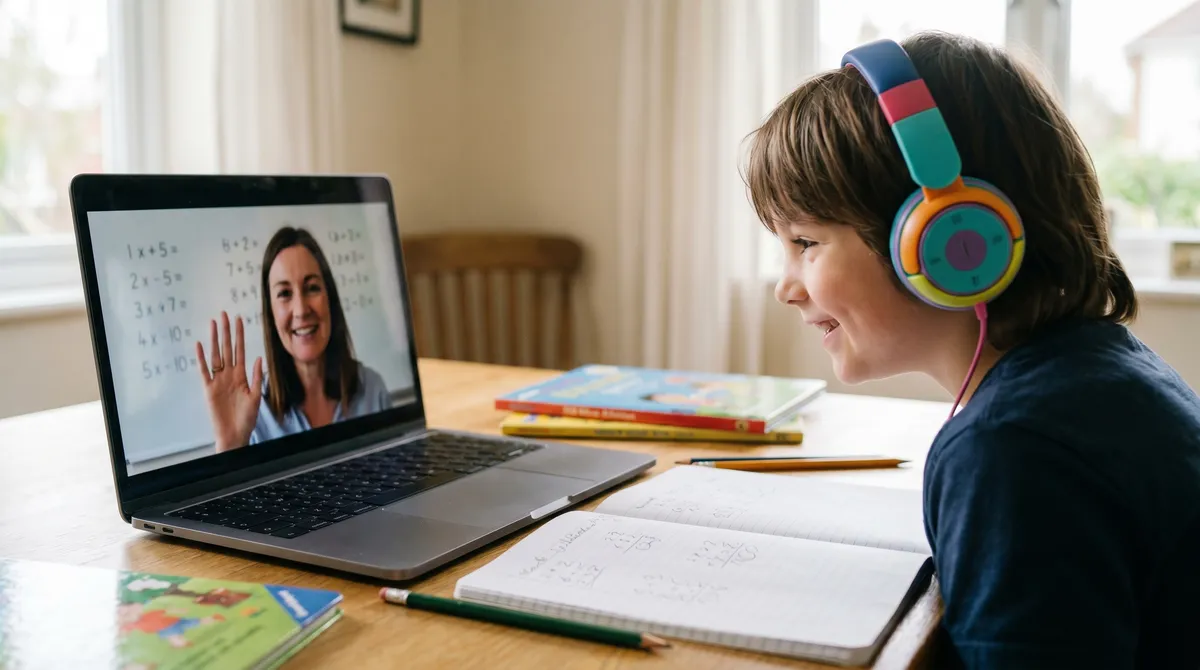
A decade ago, "tutoring" almost always meant someone driving to your house or your child going to a learning center after school. Today, online 1-on-1 math tutoring is just as common — and for many families, it is significantly more effective. Here is a clear-eyed look at how the two compare.
The Real Differences
Both formats have the same goal: a real human being teaching your child math. What changes is how that connection happens, and the trade-offs that come with it.
In-Person Tutoring: Pros
- Physical presence. Some kids — especially younger ones — focus better when there is another human in the room with them.
- Hands-on manipulatives. Counting blocks, fraction tiles, and physical math tools are easier to share at the same table.
- Fewer technical issues. No internet outages, no microphone problems.
In-Person Tutoring: Cons
- Travel time. An hour-long lesson often costs you 90 minutes to two hours when you factor in driving and waiting.
- Smaller pool of teachers. You are limited to whoever lives near you. The best math tutor in the country probably does not live ten minutes away from you.
- Higher cost. Tutors charge more to cover their travel time and the overhead of a learning center.
Online Math Tutoring: Pros
- Zero commute. Lessons happen at home, often during a window that fits real family life.
- Choose from the best teachers anywhere. Your child can be tutored by an expert math educator on the other side of the country, not just whoever lives in your zip code.
- Interactive whiteboards beat paper. Modern online tutoring tools let teacher and student write, draw, and manipulate visuals together in real time. For abstract math concepts (graphs, fractions, geometry), this is often better than a paper notebook.
- Easier to keep parents in the loop. Most online platforms include parent dashboards, recorded session notes, and weekly progress updates.
- Lower cost. No travel overhead means more of your money goes to the actual lesson.
Online Math Tutoring: Cons
- Requires a device and stable internet. Most homes have these, but a slow connection makes video tutoring frustrating.
- Younger children may need a parent nearby for the first session or two. Once the format is familiar, this goes away.
- Self-discipline matters more. A tutor on Zoom is easier to tune out than one sitting next to you. Good tutors compensate for this with interactive lessons and accountability check-ins.
Which Works Better for Your Child?
For elementary and middle school students (grades 1–8) learning math, online tutoring usually wins for three reasons:
- Math is the easiest subject to teach online. Whiteboards, equation editors, and shared scratch pads work beautifully for math problems.
- Consistency matters more than format. A weekly online session that always happens beats an in-person session that gets cancelled every time someone is running late.
- Access to top teachers matters. A nationally available expert math tutor will outperform a local generalist almost every time.
The exception: very young children (Kindergarten through about 2nd grade) who have not yet developed enough independence to focus on a screen for 45 minutes. For these students, in-person can be worth the extra cost — but starting with shorter online sessions (20–30 minutes) often works fine, too.
Ultimately, format matters most at the extremes. If your child has hit a wall — the kind of common 4th-grade math struggles that compound year after year — the right tutor can rebuild the foundation before the gaps widen. If instead they are racing ahead and bored, math tutoring for gifted children can give them the challenge a standard classroom cannot. In both cases, the teacher matters far more than whether the lesson happens online or across a table.
Try It Without Risk
The best way to know if online tutoring works for your child is to try one lesson. At Elkhawarizmy Academy, the first 1-on-1 online math lesson is completely free. No credit card, no obligation. We use it to understand where your child is, identify any gaps, and show you exactly how we would help them improve.
Try Your First Math Lesson Free
See how 1-on-1 online math tutoring can change everything for your child. No credit card required.
Book a Free Trial